Special Correspondent:
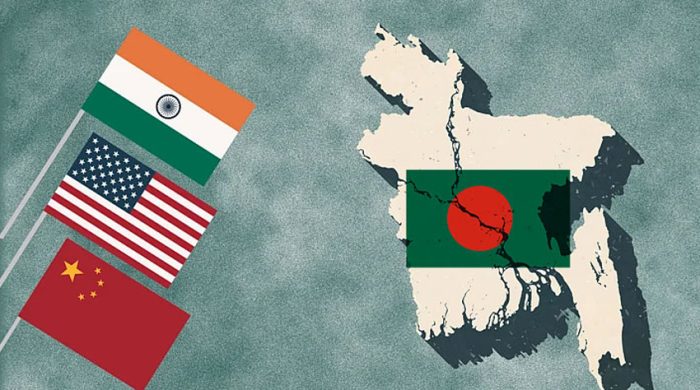
As global geopolitics undergoes rapid transformation, Bangladesh’s foreign policy is increasingly navigating a complex equation involving the competing interests of major powers, security concerns and economic priorities. While Dhaka’s trade and strategic engagement with the United States has gained new dimensions, its infrastructure, investment and defence cooperation with China has continued to expand. At the same time, Bangladesh’s longstanding relationship with neighbouring India is undergoing renewed scrutiny.
The central challenge for Bangladesh is therefore not choosing one major power over another, but maintaining national interests and strategic autonomy while managing relations with multiple competing powers.
A recent development illustrating this changing dynamic is Dhaka’s initiative to review 101 agreements and memorandums of understanding signed with India. On September 11, 2026, government Chief Whip Nurul Islam Moni said that the agreements and MoUs concluded with India under the previous government were being reviewed. A few days later, on September 18, Indian External Affairs Ministry spokesperson Randhir Jaiswal said New Delhi had not been formally informed about the matter and that India would take necessary steps to safeguard its interests.
The development cannot be viewed simply as an administrative review of bilateral agreements. It indicates a broader reassessment of Bangladesh-India relations. The geopolitical environment shaped by US pressure surrounding Bangladesh’s 2023 election, China’s growing economic and strategic presence, and India’s security interests has now been accompanied by a review of longstanding bilateral agreements.
Bangladesh’s stated approach is to prioritise national interests while avoiding excessive dependence on any single country. The policy involves expanding trade, investment, energy, technology, connectivity, security and development cooperation with major partners, including the United States, China and India, while ensuring that the country’s independent decision-making capacity is not unnecessarily constrained.
The longstanding foreign-policy principle of “friendship to all, malice toward none” is therefore facing a new geopolitical test. Bangladesh, given its strategic location, cannot remain completely insulated from competition among major powers. At the same time, excessive dependence on any one power could create economic and strategic vulnerabilities.
The United States: Trade and Strategic Engagement
Bangladesh-US relations have increasingly moved beyond political discussions towards economic and strategic issues. A significant development was the signing of the Agreement on Reciprocal Trade between the two countries on February 9, 2026.
The agreement covers market access, tariffs and trade barriers and is intended to provide a more structured framework for bilateral economic relations. According to US government information, the agreement includes measures concerning market access for Bangladeshi goods in the United States and access for US products to the Bangladeshi market.
As a result, Bangladesh’s relationship with Washington can no longer be viewed solely through the lens of past political tensions. Export markets, tariffs, investment, supply chains, technology and energy are increasingly central to the relationship.
The challenge for Dhaka is to benefit from expanded economic opportunities without creating excessive dependence. Just as the United States links trade policy with its broader economic and national-security interests, Bangladesh also needs to assess the long-term national implications of market access, investment and technology partnerships.
China: Infrastructure, Investment and Strategic Cooperation
Bangladesh’s relationship with China has also expanded significantly over the past several years. In addition to trade and investment, cooperation now covers infrastructure, connectivity, industry, technology, energy, agriculture, education and defence.
Prime Minister Tarique Rahman’s visit to China in June 2026 highlighted another phase of the relationship. During the visit, he held meetings with Chinese President Xi Jinping and Premier Li Qiang. The two sides also discussed advancing bilateral relations towards a “China-Bangladesh Community with a Shared Future in the New Era.”
The possibility of strategic dialogue and a potential “2+2” dialogue mechanism involving diplomatic and defence officials also emerged in discussions.
Modernisation and expansion of Mongla Port, the Chinese economic and industrial zone in Chattogram, connectivity infrastructure, green energy, technology and integrated management of the Teesta River are among the issues illustrating the breadth of Bangladesh-China engagement.
However, expanded cooperation with China should not automatically be interpreted as evidence that Bangladesh is moving towards a specific military or political alliance. Rather, Bangladesh’s current approach appears to emphasise maintaining relations with multiple major powers.
At the same time, long-term dependence must remain an important consideration in areas such as large infrastructure projects, loans, ports, technology, energy and defence cooperation.
One of the major practical challenges in Bangladesh-China relations is trade imbalance. Bangladesh imports substantial volumes of goods from China, while its exports to the Chinese market remain comparatively limited. Therefore, alongside deepening bilateral relations, Bangladesh faces the challenge of diversifying exports and reducing the trade gap.
Chinese investment and infrastructure projects can create opportunities for employment, technology transfer and industrial capacity. But financing structures, loan conditions, domestic industrial impacts and future financial liabilities also require careful assessment.
India: A More Complex Bilateral Relationship
Bangladesh’s relationship with India is more complicated because of geography and extensive mutual dependence. A border of nearly 4,000 kilometres, trade, connectivity, electricity, security, river-water sharing and the livelihoods of border communities all make India a unique partner for Bangladesh.
Following the political change in Bangladesh in 2024, new tensions emerged in bilateral relations. India’s hosting of former Prime Minister Sheikh Hasina, Bangladesh’s request concerning her return, border issues, trade, connectivity and river-water sharing have all become important issues in bilateral discussions.
For that reason, Bangladesh-India relations cannot be viewed solely as a component of US-China strategic competition. The relationship has its own history, interdependence and bilateral disputes.
The review of 101 agreements and MoUs with India has therefore acquired particular significance. However, a review does not necessarily mean that all agreements will be cancelled or amended. Based on the statements made so far, the focus is on examining the agreements and identifying any inconsistencies or provisions that may be considered contrary to Bangladesh’s interests.
The methodology of the review will be particularly important. The fact that an agreement was signed under a previous government should not, by itself, determine its future. Its legal framework, economic outcomes, implementation record, security implications, mutual benefits and long-term liabilities should all be considered.
India has said that it has not received any formal communication from Bangladesh regarding the review and that New Delhi will take necessary steps to protect its interests. Rather than interpreting the statement as a direct threat against cancellation of agreements, it can be understood as an indication of India’s intention to protect its bilateral interests.
The Ganges Water Treaty
Another major issue in Bangladesh-India relations is the future of the 1996 Ganges Water Sharing Treaty, which is due to expire in December 2026.
According to Indian parliamentary documents, formal negotiations on renewal had not begun as of February 2026. Information from Bangladesh’s Joint Rivers Commission also indicates that the existing agreement is scheduled to expire in 2026.
Therefore, alongside reviewing bilateral agreements, Bangladesh will need to maintain active diplomatic engagement with India on water sharing, border management, trade, electricity and connectivity.
The Teesta Question and Regional Competition
The strategic significance of Bangladesh’s geographic position has been further highlighted by the rivalry between India and China. Potential Chinese cooperation in the integrated management of the Teesta River is important for Bangladesh from the perspective of water management and development, while the project also carries strategic and geographical significance for India.
In projects of this nature, Bangladesh cannot assess potential partners solely on the basis of financing or technology. Environmental impacts, operating costs, long-term financial liabilities, technological dependence and the security concerns of neighbouring countries all need to be considered.
Energy Security and Foreign Policy
Energy security is no longer simply a domestic economic issue for Bangladesh. It is increasingly connected to foreign policy and geopolitics.
Bangladesh remains dependent on imports of LNG and other energy products. Changes in international prices, maritime security and supply chains can therefore have direct consequences for electricity generation and industrial production.
Expanding opportunities to import energy from the United States and other suppliers could provide additional options. At the same time, domestic gas exploration, energy infrastructure, diversification of suppliers and strategic reserves also require greater attention.
This means Bangladesh’s foreign policy and economic security are becoming increasingly interconnected.
China is a major trading partner and infrastructure partner. The United States is an important export market and an increasingly significant economic partner. India provides land and maritime connectivity, electricity, trade opportunities and cross-border economic links.
However, the nature of Bangladesh’s relationship with each of these countries is different. Consequently, the three relationships should not necessarily be assessed using identical criteria. Instead, Bangladesh may need to define national interests on a sector-by-sector basis.
Where markets are needed, market access should be prioritised; where investment is required, investment opportunities should be assessed; where technology is needed, technology partnerships should be considered; and where sovereignty and national security are involved, long-term strategic calculations should take precedence.
Defence Cooperation
Any future participation by Bangladesh in a new defence framework or security arrangement would also require careful assessment. Such participation should not be viewed solely through the lens of relations with the Muslim world or any particular region.
Its potential impact on Bangladesh’s security and diplomatic position would also need to be considered in the context of relations with India, the United States, China and Middle Eastern partners.
As Bangladesh’s defence cooperation expands, clear policy guidelines and long-term strategic assessments will become increasingly important.
A Balancing Act
Overall, Bangladesh cannot currently be described simply as part of a particular geopolitical bloc. Instead, the country is simultaneously dealing with US economic and strategic interests, China’s expanding political and economic engagement, and India’s security and neighbourhood interests.
The review of 101 agreements with India has made this multidimensional reality more visible. However, the eventual outcome will depend on the quality of the review process, institutional capacity, transparency in decision-making and subsequent diplomatic negotiations.
The central challenge for Bangladesh is therefore not choosing one major power over another. It is about defining national interests according to the specific needs and opportunities associated with each partnership.
The United States is important for markets and investment; China is significant for infrastructure and industrial cooperation; and India is indispensable in terms of neighbourhood relations and regional connectivity. Each relationship carries a different set of opportunities, risks and obligations.
Protecting national interests does not necessarily mean narrowing international partnerships. Rather, it means building relationships in which Bangladesh can maximise opportunities for cooperation without unnecessarily limiting its independent decision-making capacity.
Bangladesh cannot remain completely outside the competition among major powers. At the same time, becoming excessively tied to the strategic calculations of any one power could create new forms of long-term dependence.
The country therefore faces a continuing need for pragmatic diplomacy supported by strong institutions, transparent agreements, economic assessments and comprehensive security analysis.
Ultimately, Bangladesh’s geopolitical success will not be measured by how close it becomes to any particular major power. It will depend on how effectively the country can preserve its economic interests, sovereignty and strategic decision-making autonomy while maintaining productive relations with multiple competing powers.
That balance may prove to be the defining test of Bangladesh’s foreign policy in the years ahead.