After sending over a million workers overseas this year, experts warn Bangladesh remains locked in a fragile, low-skilled labour-export model dependent on one market, exorbitant recruitment costs, and inadequate protection for migrant workers.
According to data from the Bureau of Manpower, Employment and Training (BMET), 10,71,570 Bangladeshis travelled abroad for work so far this year, with Saudi Arabia alone absorbing 712,044 workers — more than half of the total. Experts say such concentration leaves Bangladesh dangerously exposed to policy shifts in the kingdom.
BMET data shows that 105,466 Bangladeshi women migrated for overseas employment in 2022, marking a recovery from the pandemic downturn of 2020. While annual figures exceeded 100,000 before Covid-19, female migration has declined steadily since then.
By 2024, the number fell to just over 60,000. Most recently, Overseas Employment Platform data shows that 56,292 women migrated between January 1 and December 6, 2025 — a drop of about 47 percent from 2022 — with no clear strategy to reverse the trend or ensure safer, skilled overseas placements.
Budgetary commitment has weakened further, as the expatriate welfare ministry’s allocation fell from Tk 1,217 crore to Tk 855 crore, averaging just 0.08 percent of national expenditure over five years, despite migrants generating over USD 30 billion annually in remittance.
Prof Tasneem Siddiqui, executive director (acting) of the Refugee and Migratory Movements Research Unit, said, “The decline in allocation sends a clear signal that migrant welfare was not treated as a priority.”
She said recent government initiatives — including a migrant lounge, overseas postal-ballot voting, and a bilateral labour agreement with Saudi Arabia — failed to bring systemic reform.
“The election initiative is symbolically important, but what the sector needed was long-term planning. Instead, the ministry focused on day-to-day administration and missed a historic opportunity to reshape migration governance.”
After the ousting of the previous government, experts repeatedly called for a “National Migration Decade” — a roadmap for skills, welfare, recruitment reform and labour diplomacy — but no such vision emerged.
THE COST BORNE BY WORKERS
The cost of migration remains the heaviest burden on Bangladeshi workers.
Shariful Hasan, associate director at the BRAC Migration Programme and BRAC Youth Platform, said workers pay three to four times more than Nepali migrants to access the same markets, as recruitment remains dominated by unregulated middlemen.
“Reducing harassment at the airport should be a priority. A lounge will not solve their problems — migrant workers want a hassle-free experience, not cosmetic fixes,” he said.
Prof Tasneem said, “The government fixed official cost ceilings but failed to enforce them. No meaningful action was taken against agencies charging excessive fees, allowing exploitation to continue openly.
“Workers paid for a system meant to protect them, while their actual welfare needs remained unmet.”
The Wage Earners’ Welfare Fund, financed by Tk 3,500 from each migrant, is increasingly spent on administration instead of aiding distressed workers.
Experts say Bangladesh remains locked into exporting low-skilled labour to low-paying markets. BMET training programmes are short, weakly accredited, and misaligned with global labour demand.
There is no effective coordination between the expatriate welfare ministry, the education ministry and vocational bodies, leaving no skilled migration pipeline. “This lack of integration kept Bangladesh trapped in low-value labour export,” said Prof Tasneem.
She said opportunities in nursing and technical professions were missed because universities are barred from offering internationally recognised nursing degrees, making overseas placement unviable.
Although legal provisions exist to register sub-agents, Prof Tasneem said the rules were designed in ways that undermine accountability.
“Proposals for centralised digital registration and police verification were ignored, giving recruiters plausible deniability and workers no clear path to justice,” she said.
Meanwhile, reports from Malaysia, the Gulf and Europe point to persistent failures in embassy services. Labour wings are often understaffed, poorly allocated, and difficult for workers to access.
A Bangladeshi construction worker in Kuala Lumpur, who has lived there for seven years, said, “When we go to the embassy, they tell us to make appointments or come later. Calls are never answered. If we face problems with employers, we get no guidance.”
He added that embassy-linked officials sometimes “create hurdles instead of solving problems,” pushing migrants toward private brokers even during emergencies.
The interim government, meanwhile, has yet to reopen key labour destinations — Malaysia, Oman, and the UAE — or revive nine previously closed markets.
Shariful warned that without progress, out-migration could drop sharply next year.
Even Saudi Arabia — Bangladesh’s most reliable destination — is tightening requirements through measures such as the Takamul certificate, alongside delays in Iqama processing, salary payments and job transfers, heightening uncertainty among workers.
“These pressures expose a deeper vulnerability,” Shariful said. “This model survives on one market. Any policy shock in Saudi Arabia can cripple the system.”
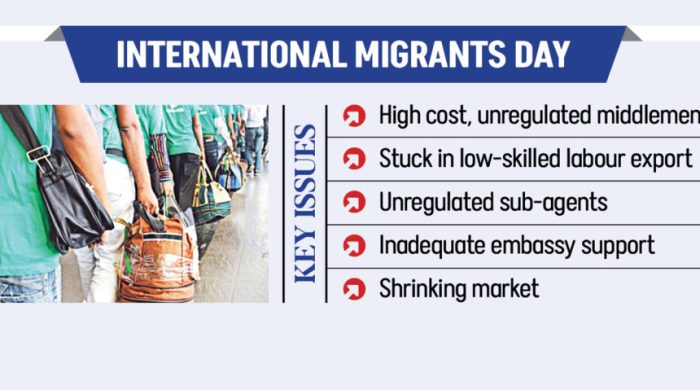
As Bangladesh marks International Migrants Day and National Diaspora Day 2025 today, many workers say the observances feel hollow.
Niloy Mazumder, a migrant worker in Malaysia, said, “We bring dollars to our country. But when we need help, nobody stands with us.”
Prof Tasneem said Bangladesh continues to prioritise remittance flows over the workers who generate them.
Prof Asif Nazrul, adviser to the Ministry of Expatriates’ Welfare and Overseas Employment, could not be reached for comment despite repeated phone calls and text messages.