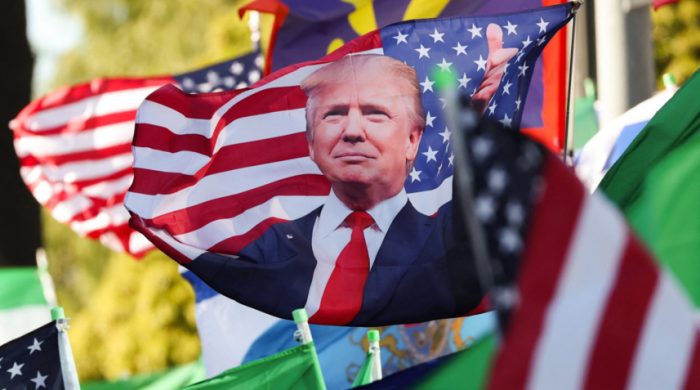
US President Donald Trump warned on Sunday that Iran’s next supreme leader would not last long without his approval, as Tehran prepared to reveal the successor to the slain Ayatollah Ali Khamenei.
Nine days into the war that killed the supreme leader, three members of Iran’s Assembly of Experts said the organisation had chosen a successor, but several hours after those statements no name had been revealed.Hossein Redaei, a member of the body, said it had gathered the votes for the next supreme leader, but said it had not been deemed appropriate to hold a public and in-person gathering given the wartime conditions.Some have suggested that Khamenei’s 56-year old son Mojtaba Khamenei would succeed his father.
Trump had previously demanded a say in the appointment and dismissed the younger Khamenei as an unacceptable “lightweight”
“He’s going to have to get approval from us,” Trump told ABC News on Sunday, referring to Iran’s next leader. “If he doesn’t get approval from us he’s not going to last long.”But Tehran’s top diplomat Abbas Araghchi said earlier in the day that the decision was Iran’s alone, adding it would “allow nobody to interfere in our domestic affairs”.
Speaking on NBC’s “Meet the Press”, Araghchi went on to demand that Trump “apologise to people of the region” for the spiralling war.The younger Khamenei is regarded as a conservative figure, notably because of his ties to the Revolutionary Guards, the ideological arm of the Islamic republic’s military.
Israel’s military has warned any successor that “we will not hesitate to target you”.
Air ‘unbreathable’
Israel’s reach was underlined by two new operations overnight — strikes against fuel dumps in and around Tehran, and an attack on a hotel in the heart of Lebanon’s capital Beirut that targeted suspected Iranian commanders.
Israel said the Beirut strike killed five Revolutionary Guards commanders, including three from the Quds Force, the Guards’ elite foreign branch.
Warplanes hit five oil facilities around the Iranian capital, killing at least four people, according to a state oil executive, and blanketing the city in acrid smoke.
Tehran’s governor told the IRNA news agency that fuel distribution had been “temporarily interrupted” in the capital.
A dark haze hung over the city of 10 million people, blocking out the sun, while the smell of burning fuel lingered in the air.
Authorities warned the fumes could be toxic and urged citizens to stay indoors, but many windows were blown out by the force of the blasts.
“The blaze has been burning for more than 12 hours, the air has become unbreathable. I can’t even go out to do the daily shopping,” said a 35-year-old from Tehran.
“At first, I supported this war. After Khamenei’s death, I celebrated with my friends: we drank wine and we danced.
“But since yesterday… people say there’s not even any gasoline left at the gas stations,” she said in a text message to Europe.
As the war ground on, Iran’s Revolutionary Guards said they had enough supplies to continue their drone and missile war over the Middle East for up to six months.
Several blasts were heard over Israel’s commercial hub of Tel Aviv after the Israeli military said it had detected a salvo of missiles from Iran. The Magen David Adom emergency services said six people were wounded in central Israel.
Advanced missiles
Trump again refused to rule out sending US ground troops into Iran, but continued to insist that the war was all but won despite the ongoing Iranian missile and drone strikes.
His comments came hours before the US military announced the death of a seventh service member, who died on Saturday in Saudi Arabia after being wounded during an Iranian attack.
Guards spokesman Ali Mohammad Naini said Iran had so far used only first- and second-generation missiles, but would use “advanced and less-used long-range missiles” in the coming days.
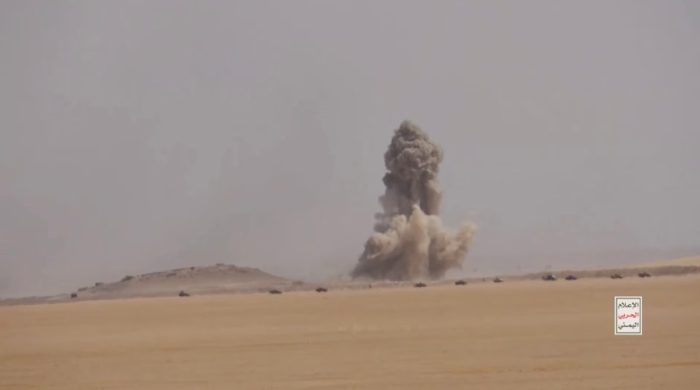
Saudi Arabia said two people were killed and 12 wounded by a “projectile” on Sunday in Al-Kharj province, having earlier said it intercepted a wave of drones headed for targets including the diplomatic quarter of its capital Riyadh.
Kuwait, meanwhile, said an attack hit fuel tanks at its international airport and Bahrain reported a water desalination plant had been damaged.
In a rare speech, Bahrain’s King Hamad bin Issa Al Khalifa said “we regret the unprecedented aggression” of Iran’s attacks, which he said “cannot be justified under any excuse”.
Iran’s health ministry said Sunday that at least 1,200 civilians had been killed and around 10,000 wounded — figures AFP could not independently verify.
Lebanon’s health minister said at least 394 people had been killed in Israeli air strikes since Lebanon was dragged into the war a week ago, including 83 children and 42 women.
Two Israeli soldiers were killed during the fighting in southern Lebanon, the Israeli military said.
Trump on Saturday attended the return of the bodies of six American service members who were killed in a drone strike on a US base in Kuwait last Sunday.
No clear way out
Analysts warn there is still no clear path to ending a conflict that US and Israeli officials say could last a month or longer.
Trump has suggested Iran’s economy could be rebuilt if a leader “acceptable” to Washington replaces the late supreme leader.
China and Russia have largely stayed on the sidelines despite close ties with Tehran.
China’s top diplomat Wang Yi said the war in the Middle East should “never have happened”, telling a press conference in Beijing: “The world cannot return to the law of the jungle.”On Sunday, Pope Leo XIV prayed “that the roar of the bombs may cease, the weapons may fall silent, and a space for dialogue may open”.