By Special Correspondent:
As Bangladesh undergoes a major political transformation following the July–August mass uprising, the challenge extends far beyond a mere transfer of power. The country now faces the urgent task of rebuilding state institutions and establishing a credible framework for future governance. At the centre of this process is the July Charter, a document widely presented as a roadmap for constitutional and institutional reform.
While the Charter has generated significant public expectations, it has also sparked debate over its political interpretation, implementation process and the extent of national consensus behind it. The key question remains whether the July Charter will bridge Bangladesh’s political divides or deepen them through partisan use.
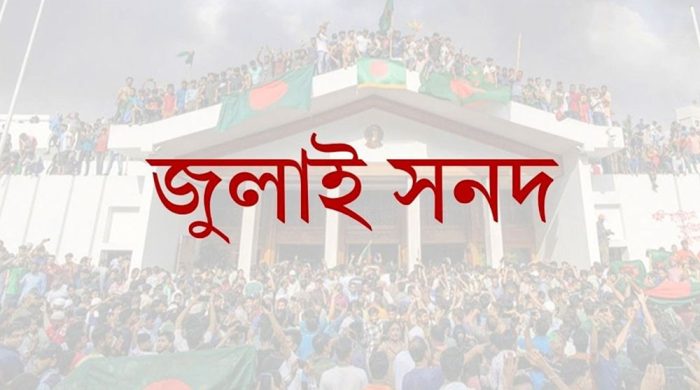
The July Charter has never been portrayed as an ordinary political manifesto. Instead, it has been presented as the institutional legacy of the July–August uprising and a framework for restructuring state institutions following one of the most significant political transitions in the country’s recent history.
The Charter outlines several long-discussed reform proposals, including strengthening judicial independence, limiting the prime minister’s tenure, improving the transparency and credibility of elections, and establishing greater checks, balances and accountability among state institutions. These issues have long featured prominently in Bangladesh’s political discourse.
However, even well-intentioned reforms can become controversial if political management falls short. The National Consensus Commission’s initiative to engage political parties in dialogue has been widely welcomed. Yet holding consultations is not the same as achieving unanimous national consensus. The Commission held discussions with 33 political parties and alliances, rather than all registered political parties.
More importantly, the Charter itself acknowledges that political disagreements remain on several fundamental issues. Consequently, while it may represent a significant political compromise, it cannot yet be regarded as a universally accepted national agreement. This distinction carries considerable political significance.
Concerns have also emerged over how some political parties, particularly Bangladesh Jamaat-e-Islami and the National Citizen Party (NCP), have presented the Charter in public discourse. Critics argue that their rhetoric often suggests the document has already attained the status of an unquestionable national mandate.
According to this interpretation, securing public approval through a referendum or expressing support for the Charter would effectively settle constitutional disputes and bind future governments to a predetermined implementation framework.
Political analysts, however, argue that such an interpretation oversimplifies democratic processes. While a referendum may provide political legitimacy for reform initiatives, it cannot replace the constitutional procedures required for constitutional amendments, parliamentary scrutiny or broader democratic deliberation. Nor can it erase the political differences explicitly acknowledged within the Charter itself.
Observers have also expressed concern over an emerging tendency to label critics of specific provisions or implementation methods as being opposed to the spirit of the July uprising or to institutional reform itself. Such an approach, they warn, risks narrowing democratic space for debate.
Supporting institutional reform does not necessarily require unconditional endorsement of every proposal contained in the Charter. In a healthy democracy, differing views on reform proposals and implementation mechanisms are considered a normal and essential part of political discourse.
The Charter’s greatest strength could lie in its inclusiveness. For it to serve as a foundation for national unity, differing opinions must be recognised rather than suppressed. Historically, political agreements that foster consensus rather than deepen divisions have proven to be more durable.
However, some observers fear that the Charter, originally intended to promote political consensus, could instead become a focal point of renewed political confrontation if it is increasingly used for partisan advantage.
This concern has placed the role of Jamaat-e-Islami and the NCP under greater scrutiny. Critics argue that if the Charter is employed primarily as a political tool to consolidate party positions instead of serving as a basis for broader national dialogue, its original purpose may be undermined.
Turning every constitutional debate into a test of loyalty to the July movement, they argue, is unlikely to facilitate sustainable institutional reform. While such an approach may yield short-term political gains, it risks creating deeper divisions in the long run.
Responsibility does not rest solely with political parties. The government is also being urged to avoid portraying the Charter as an unquestionable reflection of the collective will of all political forces and citizens.
In reality, while the drafting process involved extensive consultations and produced consensus on several issues, significant differences remain on others. Acknowledging those disagreements should not be viewed as a weakness but rather as a defining feature of democratic politics.
For many who took to the streets during the July 2024 uprising, the central aspirations were the establishment of accountable state institutions, free and credible elections, and a constitutional system capable of maintaining an effective balance of power. Few expected the movement to lead to renewed political deadlock or intensified partisan rivalry.
The July Charter still has the potential to become a historic milestone in Bangladesh’s democratic and institutional evolution. That potential, however, will depend on whether political actors treat it not as an instrument of partisan victory, but as the starting point for broader national dialogue, compromise and reform.
If the Charter’s ultimate objective is genuine state reform and national consensus, its implementation must be guided by inclusion, dialogue and mutual respect. Otherwise, a document that initially inspired hopes of national unity could instead become a catalyst for deeper political polarisation.