Special Correspondent:
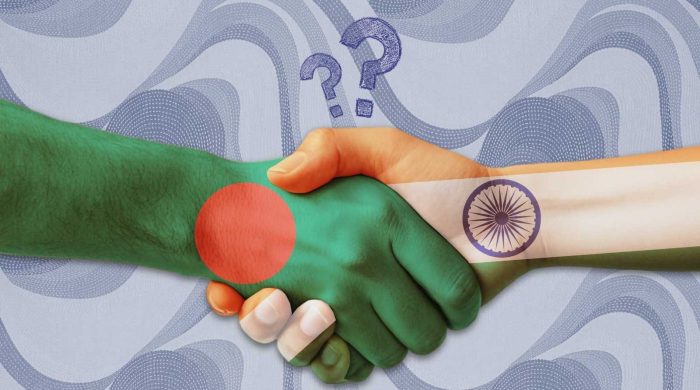
The relationship between India and Bangladesh has reached a pivotal moment, with recent diplomatic exchanges offering a potential opportunity to rebuild trust and shape a new chapter in bilateral relations.
Observers say that, much like a farmer who prepares the soil long before harvest, sustainable relations between neighboring countries require patience, foresight, and consistent investment in mutual confidence. Trust between nations, once weakened, is far more difficult to restore than to establish, while suspicion can spread rapidly and undermine years of cooperation.
Against this backdrop, recent developments between Dhaka and New Delhi have drawn significant attention. Following Bangladesh’s national election, Indian Prime Minister Narendra Modi congratulated Bangladesh Nationalist Party (BNP) Acting Chairman Tarique Rahman by telephone and invited him to attend the BRICS Summit scheduled to be held in New Delhi in September.
Analysts view these developments as more than routine diplomatic gestures, arguing that they could provide an opening to reset relations after a period marked by political uncertainty and strategic speculation.
For years, discussions surrounding India-Bangladesh relations have often been shaped by assumptions, political narratives, and public speculation rather than direct diplomatic engagement. Political changes in Dhaka, strategic calculations in New Delhi, and widespread rumors have frequently fueled mistrust between the two neighbors.
Political actors in both countries have also been accused of exploiting historical grievances for domestic political gain. As a result, diplomatic meetings are sometimes portrayed as acts of capitulation or secret deals, while disagreements are often interpreted as evidence of broader conspiracies. Such narratives, analysts argue, generate headlines but do little to strengthen long-term bilateral relations.
Bangladesh, as an independent and sovereign nation, retains the right to formulate its foreign policy according to its own national interests. That independence, achieved through decades of struggle and sacrifice, means that Dhaka’s external relations should be guided by sovereign decision-making rather than the approval of any other country.
At the same time, the unique relationship between India and Bangladesh remains rooted in shared geography, interconnected rivers, cultural and linguistic ties, centuries of historical interaction, and deep social connections that predate the creation of modern nation-states.
The strongest foundation of the relationship continues to be India’s support for Bangladesh during the 1971 Liberation War, a defining chapter in the country’s independence.
Experts, however, caution that no bilateral relationship can remain healthy if one side continually emphasizes past contributions while the other focuses exclusively on historical grievances. History, they argue, should serve as a source of confidence and guidance rather than a permanent basis for entitlement or resentment.
International experience offers several examples of former adversaries transforming their relationships. France and Germany overcame decades of conflict through political reconciliation after World War II, laying the foundation for one of Europe’s strongest partnerships. Likewise, the United States and Vietnam gradually normalized relations despite a prolonged and devastating war.
These cases demonstrate that stronger partnerships emerge not because all differences disappear, but because political leaders choose to prioritize long-term national interests over short-term political considerations.
India and Bangladesh continue to face unresolved issues, including water sharing, border management, trade imbalances, and broader regional geopolitical challenges. Analysts argue that the strength of mature bilateral relations lies not in the absence of disagreements but in the ability to manage them through dialogue, restraint, and mutual respect.
Political leaders in democratic societies are expected to respond to public opinion, but they also bear responsibility for safeguarding long-term national interests. If every diplomatic compromise is portrayed as surrender and every dialogue as a sign of weakness, meaningful diplomacy becomes increasingly difficult.
Observers believe both countries now have an opportunity to place their relationship on a stronger foundation based on sovereign equality, mutual respect, and recognition of each other’s independent decision-making.
Rather than relying solely on historical sentiment, they argue that future cooperation should be built on shared interests, practical collaboration, and mutual confidence.
As the two neighbors stand at what many describe as a rare diplomatic moment, the decisions taken today could shape bilateral relations for years to come.
Like a farmer whose harvest depends on the quality of the seeds sown months earlier, the future of India-Bangladesh relations may well depend on the choices made at this critical stage. The message, analysts say, is simple: the seeds planted today will determine tomorrow’s harvest.