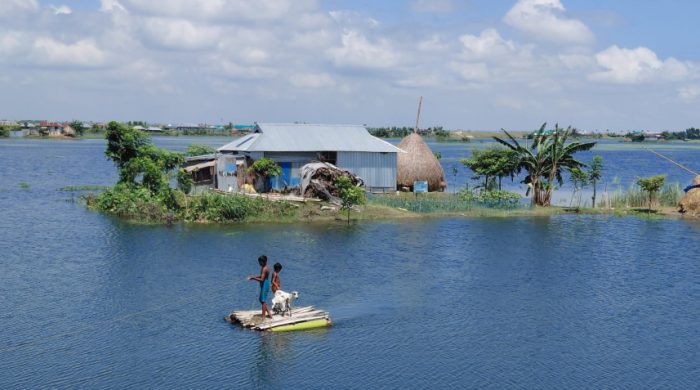
Every monsoon, vast stretches of char lands and low-lying riverbank areas along the Teesta, Brahmaputra, Dharla and Dudhkumar rivers disappear under floodwater. Homes, croplands and roads are submerged, leaving thousands of families marooned for weeks.Yet amid the floodwater, clusters of raised homesteads emerge like tiny islands, offering a rare refuge from the floods.Built six to seven feet above the surrounding ground, these elevated settlements shelter multiple families and double as makeshift flood centres, providing safety not only for their residents but also for neighbouring communities during the monsoon.Building one, however, is beyond the means of most char dwellers. Instead, three to seven families pool their savings to construct a shared cluster homestead on 10 to 20 decimals of land. The cost ranges from Tk 6 lakh to Tk 10 lakh, making it one of the few community-led solutions to the region’s recurring floods.Some receive support from the government or non-governmental organisations, but most are financed by the families themselves.Rakibul Hasan, executive engineer of the Bangladesh Water Development Board in Kurigram, said the cluster homesteads are strategically built at planned intervals to minimise the risk of riverbank erosion.The homesteads are raised by dumping layers of soil, with the top covered in clay, making the structures more durable and suitable for growing fruit, timber and medicinal trees, he said.
Hasan warned that climate change is making floods and riverbank erosion more frequent and intense across northern Bangladesh, increasing the vulnerability of char communities.Against this backdrop, cluster homesteads are becoming increasingly important,” he said. “They are not just safe shelters during floods but also a sustainable, disaster-resilient housing model for people living in Bangladesh’s vulnerable char areas.”
In Jorgachh village on the banks of the Brahmaputra in Kurigram’s Chilmari upazila, cluster homesteads were virtually unknown seven or eight years ago, said 70-year-old farmer Nehat Ali.
Today, around 150 of the village’s 200 families live on such raised homesteads.Four years ago, five families jointly built a cluster homestead on 18 decimals of land,” he said.
“We raised it about seven feet above the ground at a cost of nearly Tk 9 lakh. Now, even when floodwater surrounds us, our homes remain safe. Families whose houses go under water also bring their cattle and goats here for shelter.”
Mohor Ali, 65, also from Jorgachh, has not been able to build one because of financial hardship.
“Every year during the floods, I have to move my family and livestock to a neighbour’s raised homestead,” he said.
“It is impossible for a single family to bear the construction cost.”
He and three neighbouring families have now decided to build one together during the coming dry season.In our char area, these homesteads have effectively become flood centres,” he said.
In Haripur village on the banks of the Teesta in Gaibandha’s Sundarganj upazila, the surrounding area remains submerged despite falling river levels, said farmer Jalal Uddin.
“Water is everywhere, but our cluster homesteads remain dry and safe.”
Seventy families in the village live in 18 such homesteads in an area that typically remains inundated for four to five months during the monsoon.
“We are safe at home, but transportation becomes our biggest challenge,” Jalal said.
“To reach the mainland, we rely on banana-tree rafts, makeshift floats made from plastic drums, or boats. Children, elderly people, women and men—everyone has become accustomed to travelling this way.”
In Dipchar Falimari village on the Dharla shoal in Lalmonirhat Sadar upazila, around 300 families live in the area.
Nearly 200 have moved onto cluster homesteads, while the remaining 100 are still unable to build them because of financial constraints.
Life during the floods used to be extremely difficult before the raised settlements were built, said 60-year-old farmer Amzad Hossain.
“Now we can stay safely throughout the flood season. Landless families have also built cluster homesteads on government khas land with support from the government and NGOs. We have planted mango, jackfruit, banana and papaya trees around our homes and grow vegetables as well. Families living here share responsibilities and live together in harmony.”
Ahsanul Kabir Bulu, who works on livelihood programmes in Kurigram’s char areas for a non-governmental organisation, said cluster homesteads have evolved into an effective climate adaptation solution for communities facing recurring floods and riverbank erosion.
As extreme weather events become more frequent, these elevated settlements are helping vulnerable families stay safer while reducing the impact of annual disasters, he said.
Lalmonirhat District Relief and Rehabilitation Officer Abdul Matin said the homesteads are also serving as community-level flood shelters across char and other low-lying riverbank areas.
“If several families jointly apply to build a cluster homestead, they can receive government assistance,” he said.
“Landless and extremely poor households are given priority.”