Economic Correspondent:
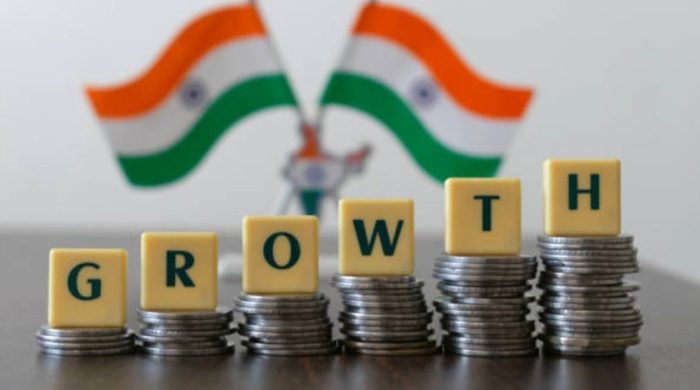
India’s economy is projected to reach approximately $5.1 trillion in nominal GDP by the financial year 2028–29 (FY29), according to the International Monetary Fund’s (IMF) World Economic Outlook (April 2026). The projection was shared by Finance Minister Nirmala Sitharaman in a written reply in the Rajya Sabha.
The Finance Minister said the government has adopted a comprehensive growth strategy focused on agriculture, manufacturing, MSMEs, infrastructure, digital technology, and structural reforms to achieve the milestone while advancing its long-term vision of building a “Viksit Bharat” (Developed India) by 2047.
Key Growth Initiatives
Manufacturing and Industry
To strengthen domestic manufacturing and attract investment, the government is promoting initiatives such as the Production Linked Incentive (PLI) Scheme, Make in India, PM Gati Shakti, and the National Logistics Policy.
Support for Micro, Small and Medium Enterprises (MSMEs) has been expanded through the Emergency Credit Guarantee Scheme (ECGS), simplified Udyam Registration, and the PM Vishwakarma scheme.
Services and Emerging Sectors
The government is also investing in Digital Public Infrastructure (DPI), expanding Global Capability Centres (GCCs), and strengthening India’s artificial intelligence (AI) ecosystem.
As announced in the Union Budget 2026–27, the government plans to establish a National Hospitality Institute, develop regional medical hubs, and set up AVGC (Animation, Visual Effects, Gaming and Comics) Content Creator Labs.
Strategic sectors such as semiconductors, electronics, clean energy, and biopharmaceuticals have been identified as priority areas. The PM-SETU programme is expected to help create a technology-driven skilled workforce.
Agriculture and Trade
The government is focusing on improving irrigation, promoting technology adoption, encouraging crop diversification, and strengthening agricultural marketing systems.
At the same time, efforts are underway to expand Free Trade Agreements (FTAs) and improve the ease of doing business through GST and income tax reforms.
Banking Sector Update
In a separate written reply, Finance Minister Sitharaman said that under the SARFAESI Act, banks filed 215,709 cases involving ₹1,03,180 crore of non-performing assets (NPAs) during FY2024–25.
She added that banks successfully recovered ₹32,466 crore from these cases, reflecting continued efforts to improve recovery of bad loans through legal mechanisms.