Special Correspondent:
If democracy is to be upheld, the fundamental principle is that sovereignty rests with the people. A government that receives a public mandate through elections is the legitimate government of a country and is expected to govern for its constitutionally determined term.
Against this backdrop, political demands to bring down a government within a specific timeframe—such as December—raise questions about the nature of democratic practice and the role of street politics in determining the fate of an elected government.
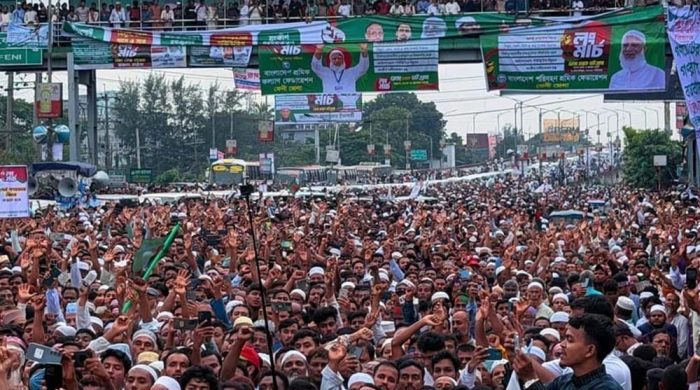
The recently held Dhaka–Chattogram-bound mass procession by an 11-party alliance was more than an ordinary opposition programme. The large gatherings, the long procession on the highway and the speeches delivered by alliance leaders have generated fresh debate over the future direction of Bangladesh’s politics.
At Mahipal in Feni, Jamaat-e-Islami Amir and opposition leader Dr Shafiqur Rahman warned of the “footsteps of fascism.” LDP Chairman Col. (retd.) Oli Ahmed went further, setting December as a deadline for bringing down the government and calling on alliance supporters to prepare to assume power.
The statements have raised a fundamental question: What does the December deadline actually mean in a democratic political system?
The six-point demands raised by the 11-party alliance include several issues closely linked to public concerns, including the trial of those responsible for the July killings, implementation of the referendum verdict, relief from rising prices and the energy crisis, and freeing the administration from political influence.
Such demands, particularly when they reflect genuine public grievances, cannot easily be ignored by any responsible government.
The bigger question, however, concerns not the demands themselves but the method being used to pursue them.
Protests, demonstrations and political movements are legitimate components of democratic politics. Citizens and political parties have the right to express dissent and put pressure on the government.
But can sustained street pressure become an alternative to a national mandate obtained through elections?
When NCP leader Nahid Islam signals that the six-point demand could eventually be transformed into a “one-point” movement, alongside calls for continued street agitation, another question naturally emerges: Can the political strength displayed on the streets determine when an elected government should leave office?
The Dhaka–Chattogram highway programme demonstrated the organisational strength of the alliance and its ability to mobilise large numbers of people.
Large rallies have long been a feature of South Asian politics, and mass gatherings can certainly demonstrate the strength of a particular political movement or reflect the sentiments of a section of society.
But a few kilometres of a crowded highway are not equivalent to the ballot boxes across an entire country.
Treating street mobilisation as the sole expression of national public opinion carries political risks. There is a fundamental difference between defeating a government through an election and forcing it out through prolonged political pressure.
If that distinction becomes blurred, democratic institutions themselves may be weakened.
There may be legitimate public grievances over politicisation of the administration, governance failures or problems related to electricity and essential services.
However, describing every administrative failure or policy disagreement as “fascism” risks diminishing the historical and political significance of the term.
Those who accuse the government of authoritarianism while remaining in opposition also face a question from the public: If they come to power, will they genuinely make state institutions independent, or will they simply replace the old faces within the same system?
The credibility of any political movement ultimately depends not only on what it says while in opposition but also on how it behaves when it gains power.
The political role and democratic credentials of Jamaat-e-Islami have remained subjects of extensive debate.
Participation in elections or the ability to operate legally in politics, by itself, does not necessarily establish a party’s democratic credentials. Those credentials are built through consistent political conduct and respect for democratic institutions.
Jamaat’s role in the 1971 Liberation War and the subsequent history surrounding the International Crimes Tribunal have created an additional political burden for the party.
If Jamaat seeks to establish itself as a force committed to democratic values, it will need to demonstrate its commitment to institutional accountability, pluralism and responsible governance—even before assuming state power.
The National Citizen Party (NCP), meanwhile, emerged from the July movement with a promise of a “new politics,” positioning itself against dynastic politics and the traditional culture of political control and occupation.
Its decision to take to the streets alongside Jamaat and other established political forces, however, has prompted questions about the distinctiveness of that new political identity.
If political strategy ultimately reproduces the practices of the old political culture, critics may ask, where does the NCP’s promised “new politics” begin and end?
Amid the growing political uncertainty, questions about regional and international influence have also resurfaced.
Past comments by Malaysian PAS leader Abdul Hadi Awang regarding foreign intervention, as well as broader discussions surrounding Bangladesh’s political transition in 2024, have fuelled concerns about the potential influence of external actors on the country’s political trajectory.
Ultimately, the country’s political future and the process through which power changes hands should ideally be determined internally, through the will of the Bangladeshi people and without undue external interference.
Whether any political change will actually take place in December, as predicted by Oli Ahmed, remains to be seen. The deadline could prove to be a serious political turning point—or, like many previous political ultimatums, it could pass without producing the predicted outcome.
But the significance of December lies less in the month itself than in the political method being proposed.
In a democracy, victories and defeats between governments and opposition parties are a normal part of political life. Governments can change through elections, by losing a parliamentary majority, or through constitutionally established processes.
The larger concern arises when the outcome is determined on the streets before an election takes place, leaving an election to merely formalise a decision already made elsewhere.
That leads to the central question facing Bangladesh’s politics today:
Who ultimately decides the transfer of political power—the people through the ballot box, or political strength on the streets?