Special Correspondent:
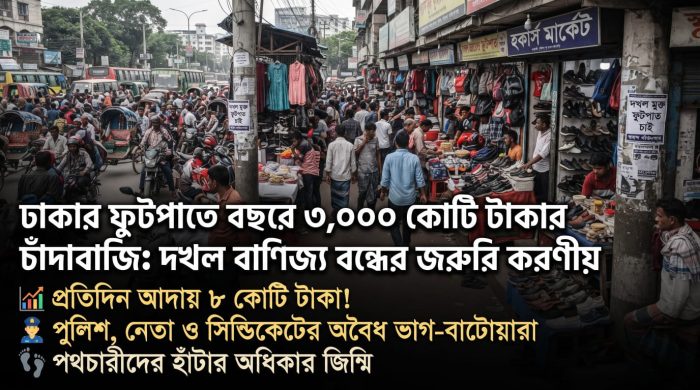
Dhaka’s footpaths, originally designed to ensure safe and convenient movement for pedestrians, have increasingly turned into centres of an extensive illegal trading network allegedly operated by powerful syndicates.
According to information from the Bangladesh Hawkers Federation and various research findings, an estimated Tk 30 billion (Tk 3,000 crore) is collected annually through extortion from hawkers operating on footpaths under the jurisdiction of Dhaka’s two city corporations.
The massive underground economy not only deprives pedestrians of their right to use public walkways but also creates serious disruptions to everyday urban life.
Number of hawkers and daily collections: According to the Bangladesh Hawkers Federation, approximately 270,000 hawkers regularly operate across Dhaka North and South City Corporations. The number reportedly rises to around 320,000 during the Eid season.
If each hawker pays an average of Tk 300 per day in illegal payments, daily collections exceed Tk 80 million.
A previous study by BRAC University’s Institute of Governance and Development (BIGD) estimated the annual amount at Tk 18.25 billion (Tk 1,825 crore). However, the figure is now reportedly estimated to have increased to Tk 30 billion (Tk 3,000 crore), according to a researcher cited in the information provided for this report.
Areas under pressure:Gulistan, New Market, Baitul Mukarram, Paltan, Motijheel, Dainik Bangla intersection, Golap Shah Mazar, Zero Point, Bangabandhu Avenue and Fulbaria are among the areas with particularly high concentrations of roadside vendors.
However, the practice is not limited to these locations. Hawkers operating from small shops and pushcarts across almost every neighbourhood of Dhaka reportedly face daily demands for payments ranging from Tk 200 to Tk 300.
Rates based on stall size and business type: The amount collected varies depending on the size of tables or platforms and the type of merchandise being sold. Payments reportedly range from Tk 100 to as much as Tk 1,500 per stall.
Additional charges are also allegedly collected under the labels of electricity bills and security fees, including Tk 100 per light bulb.
Complaints from hawkers and findings cited by researchers point to an organised network behind the collection and distribution of illegal payments.
According to research attributed to BRAC University’s Institute of Governance and Development, the collected money is reportedly divided among three groups:
Police and city corporation authorities have repeatedly denied allegations of involvement in extortion. They have also stated that action would be taken if specific evidence were presented. Nevertheless, hawkers and pedestrians continue to face the consequences, with no lasting solution in sight.
These allegations and the reported financial breakdown require independent investigation and verification by the relevant authorities.
Restoring Dhaka’s footpaths for pedestrians requires coordinated, transparent and long-term measures. The following steps could help address the problem:
Authorities should establish a comprehensive database of hawkers operating across Dhaka. Registered vendors should receive official identification cards and legally recognised business permits.
A transparent system of government-approved fees or taxes could replace illegal collections. The money would then go directly into public funds rather than the pockets of unauthorised intermediaries and syndicates.
Strict legal action must be taken against individuals and groups involved in illegal collections, including alleged syndicate members, line managers and politically influential figures.
Any corrupt officials or employees of law enforcement agencies and city corporations found to be involved should face impartial investigations and exemplary punishment in accordance with the law.
Footpaths must remain fully accessible to pedestrians. However, recognising the economic realities of hawkers, authorities could designate specific locations in less congested areas or allocate limited trading hours, such as evenings and holidays.
In the long term, hawkers should be gradually relocated from pedestrian walkways to modern markets, designated hawker markets or specially developed vending zones.
An independent monitoring body should be established with representatives from local government, law enforcement agencies, civil society and local communities.
Regular and transparent eviction drives should be conducted. More importantly, authorities must ensure that evicted spaces are not reoccupied by the same networks immediately after enforcement operations.
Permanent monitoring and accountability mechanisms are essential to prevent the recurrence of illegal occupation.
Dhaka’s footpaths are not merely commercial spaces; they are an essential part of the city’s public infrastructure and a fundamental right of its pedestrians.
Addressing the problem does not simply mean evicting hawkers. It requires dismantling the alleged extortion networks, ensuring accountability, protecting legitimate livelihoods and establishing a sustainable system of urban management.
Breaking the cycle of political influence, corruption and illegal occupation will require strong political commitment and coordinated action from the government, law enforcement agencies and both city corporations.
The time has come to reclaim Dhaka’s footpaths—not only for pedestrians, but also for a safer, more orderly and liveable city.