A blow-by-blow account of a 19-year-old’s alleged journey from domestic work to drug dependency, forced marriage and trafficking to China
When Rima (not her real name) left her village in Bagerhat around six months ago, she believed her destination was Dhaka for domestic work.She had studied up to class six, worked for around three years at Salam Jute Mill near the Rupsha intersection, married young, and had a three-year-old son. Her husband did irregular agricultural work, and repeated financial strain pushed her back to her father’s home.With a child to care for and little income, she began looking for work. A distant relative then offered a way out: a job at a house in Baridhara.
Rima never reached such a workplace.
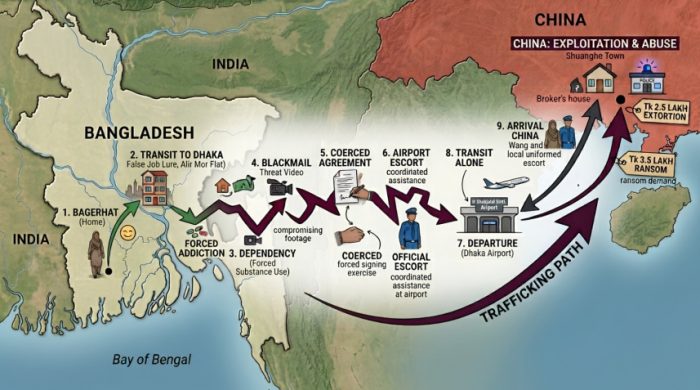
Instead, she was taken to a flat in the capital, forced to take yaba until she became dependent on it, threatened with compromising videos, married to a Chinese national through paperwork she did not understand, and sent alone to China.There, according to her own account, she was confined, tied up, beaten, and sexually abused before escaping during a visit to a doctor.
The 19-year-old returned to Bangladesh on Tuesday night with support from Justice and Care.The Daily Star interviewed Rima, reviewed court filings and documents, and spoke to investigators, anti-trafficking organisations and law enforcement officials to reconstruct what she says happened.The trap begins
Rima said the woman who brought her to Dhaka was known to her family through distant kinship and was the mother of a woman named Nayma.
The promise was specific: she would work in a house in Baridhara.
But after reaching Dhaka, she was taken to a flat near Alir Mor in North Badda, close to Nilachal School and College, where she was kept. The woman’s son, daughter-in-law, grandchild, and another son were living there.
For the first few days, nothing unusual happened. Then the woman took her into a room and began pressuring her to take yaba.
Rima initially resisted. The woman told her the drug would help her stop thinking about her son, ease her distress, and allow her to work without crying.They told me I would not keep thinking about my child, that there would be less pressure in my head and I would be able to work normally,” she recalled.
She was forced to take the drug four or five times. Before long, she began craving it. The same people who had created the dependency then controlled her access to it.
“When I needed two, they would give me half,” she said. “I became restless.”Her contact with her family weakened. She no longer wanted to speak them and sometimes abused relatives over the phone.
She said the drug had become the centre of her life.
At the flat, she also saw another young woman, Sajida, being brought in and given yaba.
She later learnt from Nayma that Sajida had been sent to China a day before her own flight. Rima said Sajida remains in China. The Daily Star could not independently verify that claim.The forced marriage
The marriage proposal came after Rima had become dependent on yaba. She said her relatives told her a Chinese man would marry her and provide financial support to her family.
She initially refused because she could not stop thinking about her son.
That was when the threats intensified.
Rima alleged that videos had been recorded of her while she was under the influence of drugs. They showed her the footage and threatened to send it to her family and child, making her feel she could never return to her previous life if the videos were released.
A woman named Sumona later took her from the flat to Jamuna Future Park, where she met a Bangladeshi intermediary she knew as Ador. Nayma, whom Rima said was then living in China, joined by phone, while Ador brought the Chinese man.
“He only looked at me,” Rima said. “They took a photograph.”
There was little conversation before she was taken back to the flat, where she stayed for another month. During that time, she was given food and small quantities of yaba. Nayma later returned to Bangladesh and, according to Rima, sometimes took the drug with her.
Her passport was arranged during this period. She was taken to a passport office, where it was issued within a day, and later to the Chinese embassy, although she could not explain how her visa was processed or what documents had been submitted.
She described the marriage as little more than a signing exercise at a place she identified as “Bismillah Coffee Shop” somewhere in Dhaka. Ador, Sumona and Ador’s wife were present. She was handed a document and told where to sign.
“No one explained anything. They only gave me a paper and told me to sign there,” she said.
The journey to China
Around a month later, Rima received a call telling her it was time to go to the airport.
Nayma and a man who worked for Ador took her to Hazrat Shahjalal International Airport. Her Chinese husband had already left Bangladesh, and Rima travelled alone.