Special Correspondent:
For families who lose a loved one, arranging a dignified burial is one of the most emotionally difficult moments in life. But in Dhaka, finding a final resting place for the deceased is increasingly becoming an issue not only of grief, but also of money.
Many families prefer to bury their loved ones in the capital despite knowing that graves may later be reused because of the acute shortage of burial space. Those who can afford it are paying exceptionally high amounts to preserve a grave for years—sometimes spending more than the price of land or even a flat for just a few feet of burial space.
At Banani Graveyard, for example, preserving a grave for 25 years officially costs Tk 1.5 crore. In some cases, however, the total cost is reportedly much higher, reaching up to Tk 4.5 crore.
The situation has raised questions over whether the capital’s graveyard management system is becoming increasingly unequal, with the ability to pay determining how long a family’s final connection with a loved one’s grave can be maintained.
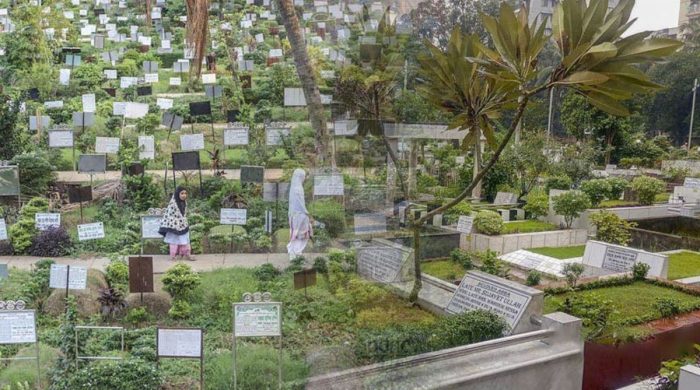
Dhaka, home to nearly three crore people, has only 13 government graveyards. According to city corporation data, these graveyards occupy a combined 253 acres of land and have a total burial capacity of 233,578 people.
Of the total land, 192 acres are under the Dhaka North City Corporation (DNCC), while only 61 acres are under the Dhaka South City Corporation (DSCC).
The limited amount of burial land compared with the city’s enormous population has made graveyard management increasingly difficult.
As new land is not being added at a rate corresponding to the number of deaths, reusing old graves has become a regular practice in several graveyards. In some places, a grave is reused after two years.
For families, this creates another source of anxiety. After burying a loved one, they often remain uncertain about how long the grave will remain intact.
Under DNCC’s graveyard policy, preserving a grave at Banani Graveyard costs Tk 1 crore for 15 years and Tk 1.5 crore for 25 years.
At Uttara Sector 4 Graveyard, the fees are Tk 75 lakh and Tk 1 crore respectively for 15 and 25 years.
At Uttara Sector 12, the fees are Tk 50 lakh for 15 years and Tk 75 lakh for 25 years. At Uttara Sector 14, they are Tk 30 lakh and Tk 50 lakh respectively.
At Mirpur Martyred Intellectuals Graveyard, preserving a grave costs Tk 20 lakh for 15 years and Tk 30 lakh for 25 years.
At the Rayerbazar graveyard adjacent to the Rayerbazar killing field, the fees are Tk 10 lakh and Tk 15 lakh for the same periods.
However, there are allegations that the actual cost can be considerably higher than the officially prescribed fees. In Banani, the total expenditure for preserving a grave for 25 years has reportedly reached as high as Tk 4.5 crore in some cases.
Such costs make long-term grave preservation practically inaccessible to most middle- and lower-income families.
The shortage of burial space is not the only concern. Allegations of unofficial payments at different stages of burial and grave maintenance have also emerged.
In April 2025, when a resident of Sutrapur in Old Dhaka, identified as Rafiqul Islam, died, his family buried him at Jurain Graveyard.
According to a family member, the official burial fee charged by the city corporation was Tk 1,000. However, the family ended up spending approximately Tk 10,000 to complete the burial.
The family also alleged that they had to pay Tk 300 for a wooden nameplate and another Tk 1,000 for decorating and temporarily maintaining the grave.
They were subsequently told to pay Tk 500 a month to keep the grave intact.
The family feared that if the monthly payment stopped, the grave might be levelled and the space reused for another burial.
If true, such practices mean that a family’s financial burden does not necessarily end after the burial. Relatives may also have to continue making payments simply to preserve the visible existence of a grave.
City corporations have their own cleaners and funeral workers at graveyards. Yet, allegations have emerged that large numbers of informal workers are also operating in some graveyards.
These individuals reportedly introduce themselves as “support workers” and offer services such as arranging burials, decorating graves, installing bamboo fences, planting grass, watering graves and providing regular maintenance.
According to allegations, installing a bamboo fence can cost between Tk 2,000 and Tk 6,000, while decorating a grave or planting grass may cost around Tk 1,000.
Families may also be asked to pay Tk 300 to Tk 500 a month for watering and maintaining a grave.
There is no evidence in the allegations that these payments are formally authorised by the city corporations. Questions have therefore been raised about how such activities continue inside graveyards and whether effective action is being taken against those collecting the money.
A worker who has been employed at the Rayerbazar graveyard for years reportedly admitted to taking such payments from families. The worker also alleged that a portion of the money goes to corrupt city corporation employees. The allegation, however, requires independent verification.
DNCC’s Graveyard Policy-2022 does not permit permanent structures or fencing over ordinary graves using bamboo, bricks, iron grills or other materials.
Yet allegations of collecting money for bamboo fencing, decoration and maintenance continue to surface.
This raises several questions: If such activities are not permitted under the policy, how are they taking place inside graveyards? Who is collecting the money? And why do such practices continue despite complaints from bereaved families?
The shortage of space has also resulted in multiple members of the same family being buried in some preserved graves. In some cases, as many as seven people have reportedly been buried in a single grave.
However, the opportunity for reburial is not open to everyone. Under the policy, reburial is limited to close relatives, including the deceased person’s children, spouse, parents and siblings.
The practice itself reflects the extent of the pressure on burial space in the capital.
The current cost of grave preservation becomes more striking when compared with historical records.
According to available information, in 1996, permanently purchasing grave space at Banani and Uttara Sector 4 cost Tk 1.2 lakh. At Mirpur Martyred Intellectuals Graveyard, grave space was available for Tk 25,000 to Tk 35,000.
Permanent grave sales were suspended between 2005 and 2007. From 2008, a time-based grave preservation system was introduced.
Before preservation fees were increased in 2023, the maximum charge at Banani was Tk 24 lakh for 15 years and Tk 45 lakh for 25 years. The fees were subsequently increased significantly.
Mohammad Mamun-ul-Hasan, DNCC’s Chief Social Welfare and Slum Development Officer, said the cost of ordinary burial had not been increased.
According to him, the high fees for long-term grave preservation are intended partly to discourage people from preserving graves for extended periods. Otherwise, he said, the shortage of burial space in Dhaka could become even more severe if everyone sought long-term preservation.
The explanation indicates that the shortage of burial land is a key factor behind the city’s policy of restricting long-term grave preservation.
The situation presents a difficult contradiction.
On one hand, Dhaka is facing an acute shortage of burial space. On the other, people with sufficient financial means can preserve graves for 15 or 25 years by paying tens of lakhs or even crores of taka.
For a lower- or middle-income family, maintaining a grave for several years may mean paying a few hundred taka every month. For wealthier families, long-term preservation can be secured by paying a substantial lump sum.
The result is an emerging perception that economic capacity can influence how long a family can maintain a loved one’s final resting place.
The experience of Uttara Sector 4 resident Abu Raihan illustrates the difficulty faced by some families.
After his maternal uncle, Abdul Ali, died, the family wanted to bury him in Dhaka. But they could not afford the high cost of preserving a grave. Eventually, he was buried in their ancestral home in Kushtia.
The fundamental problem is clear: 253 acres of government graveyard land cannot adequately meet the long-term burial needs of a city of nearly three crore people.
As the number of deaths continues to rise, the demand for new burial space will also increase. Without additional land and better management, the reuse of old graves will remain unavoidable in many locations.
But the crisis goes beyond land.
It also involves management, transparency, economic inequality and allegations of unofficial payments for burial, grave maintenance, fencing, nameplates and other services.
Experts and city authorities need to consider a long-term strategy for graveyard management in Dhaka. This could include developing new graveyards, improving the management of existing ones, maintaining comprehensive digital records and ensuring transparency in burial and preservation fees.
Effective monitoring is also necessary to prevent unauthorised collection of money inside graveyards and to ensure that complaints from bereaved families are investigated promptly.
A grave is more than a piece of land. It represents a family’s memories, relationships and history.
While the shortage of burial space is a genuine urban-management challenge, the system also needs to ensure that preserving a loved one’s grave does not become an option available only to those who can afford to pay large sums of money.
Dhaka’s 13 government graveyards, covering 253 acres, cannot meet the burial needs of a city of nearly three crore people indefinitely. The solution therefore cannot rely solely on reusing old graves or increasing preservation fees.
What is needed is a long-term, transparent and humane graveyard management plan—one that addresses the shortage of land while also protecting bereaved families from unauthorised charges and unnecessary financial pressure.
In the end, people leave behind neither wealth nor status. What remains is a name, a memory and a few feet of earth.
The question is whether even that final resting place should become a source of financial hardship for some and a lucrative opportunity for others.