Special Correspondent:
The government has taken an initiative to prepare master plans ranging from major cities to the upazila level as part of efforts to bring the country’s unplanned urbanisation and housing development under an integrated planning framework.
At the same time, the approval process for building construction is being strengthened by integrating architectural, structural and electrical designs, while measures are also being taken to ensure that buildings are constructed in accordance with approved plans before occupancy certificates are issued.
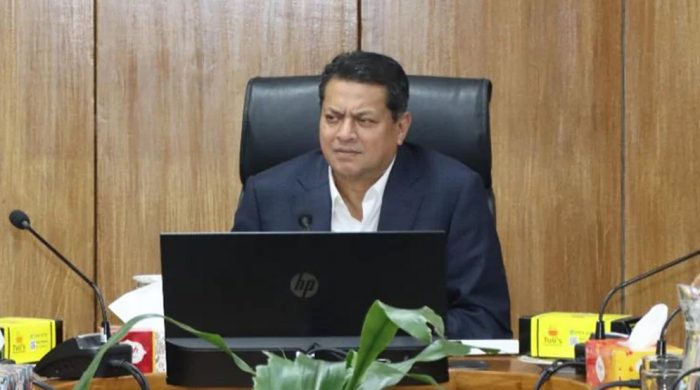
Housing and Public Works Minister Zakaria Taher disclosed the plans, saying several initiatives have already been undertaken to develop urban areas and housing in a planned manner.
“We are now trying to bring architecture, structural and electrical planning together under a comprehensive planning framework,” he said.
The minister said it was equally important to ensure that an approved building design was properly followed during construction. Under the proposed system, designers concerned would be required to certify that a building had been constructed in accordance with the approved design before an occupancy certificate was issued.
He said a number of initiatives concerning urban development and housing management had been underway over the past seven months under the Prime Minister’s directives. Proposals submitted by different stakeholders were also being considered for implementation, he added.
The Urban Development Directorate (UDD) has, for the first time, adopted a 10-year plan to carry out planned urban development across the country, the minister said.
“Initially, metropolitan cities are being given priority. Subsequently, realistic master plans will be prepared for every area, from major cities to upazilas,” he said.
He said zoning would be carried out based on the needs and potential of individual areas, determining where residential, commercial and other types of development should take place.
“Development without a master plan is like shooting four arrows at a target and hoping that one will hit it,” Taher said. “That approach cannot work for planned development. We must proceed on the basis of specific and comprehensive plans.”
He said the government was therefore giving priority to strengthening the UDD and enhancing its capacity.
The minister stressed the importance of reliable and up-to-date data for proper urban planning.
He said the country’s latest population census was conducted several years ago and that a new, appropriate census was needed to determine the current situation regarding population, settlements, housing and urbanisation.
“Effective future planning will only be possible if we have accurate information on the current situation,” he said.
Regarding building approvals, Taher said the Rajdhani Unnayan Kartripakkha (RAJUK) had approved building designs in Dhanmondi and various other areas under its jurisdiction and the Ministry of Housing and Public Works.
However, many buildings had been constructed in other areas without approved plans, he said, adding that authorities were working to identify such structures.
The minister also said long-term initiatives had been taken to protect the environment and improve conditions in Gulshan, Banani, Baridhara and Hatirjheel.
According to him, the Prime Minister had held six meetings with relevant stakeholders on the issue.
Taher said there were around 4,300 houses in Gulshan, Banani and Baridhara, and approximately 70 to 80 percent of them did not have the septic tanks and soak wells that were required at the time of construction.
He also alleged that many reputed developers had constructed buildings without installing sewage treatment plants (STPs) for waste management.
He said several meetings had been held with the Gulshan, Banani and Baridhara societies to raise awareness and address the issue.
Representatives from RAJUK, the Ministry of Housing and Public Works, the Local Government Division and Dhaka WASA, among others, participated in the meetings, he added.
“Gulshan and Baridhara are important and specialised areas of the country. If we cannot protect the water and environment of the lakes in these areas, it will be even more difficult to improve environmental management across the country,” Taher said.
The minister also announced that new development authorities had been established to strengthen urban management.
He said six new development authorities had been formed over the past seven months in Mymensingh, Sylhet, Cumilla, Narayanganj, Rangpur and Barishal, following the model of RAJUK.
Four development authorities had already existed, he said, adding that similar initiatives were being taken gradually in other areas, including Bogura.
According to Taher, in areas where there is no development authority, city corporations often have to undertake building-plan approval and implementation responsibilities themselves.
“This can create a lack of effective checks and balances,” he said, citing examples from different parts of Dhaka.
He also mentioned that in some areas, including Basila, building plans had been approved even at the union level.
The government is working to bring such issues under a comprehensive legal framework, he said.
Taher said new regulations were also being drafted to deal with buildings constructed without approval or structures built in violation of approved plans.
The proposed regulations could be placed before the Cabinet within a month, he said.
Once approved, the new rules would make enforcement of laws relating to building construction and monitoring more effective, he added.
The minister also stressed the need for long-term financing to expand housing opportunities for middle- and lower-middle-income people.
He said financial institutions had a crucial role to play in ensuring housing for a large section of the population.
“Many developed countries provide mortgage facilities for up to 30 years. Without a similar long-term financing mechanism, it will be difficult to ensure housing on a large scale in Bangladesh,” he said.
He added that the government would support the private sector if it came forward with initiatives in this area.
The government has also taken steps to reform policies governing the private housing sector, Taher said.
He said a new policy had been formulated following discussions and consultations with relevant stakeholders.
Under the new policy, private housing projects would have to be implemented within the prescribed planning framework and conditions.
Approval of subsequent projects would also depend on whether previous projects had been implemented properly, he said.
The government is also working to bring the private housing sector under a stronger legal framework to prevent unplanned urbanisation, Taher added.
Speaking about Dhaka’s liveability, the minister said the capital ranked 171st among 173 cities globally in terms of liveability.
“Making Dhaka liveable will require simultaneous efforts in multiple sectors,” he said.
However, he acknowledged that the task would be difficult because of the capital’s excessive population density.
Success would require proper planning and coordinated participation from different sectors, he said.
Referring to World Habitat Day on October 5, Taher said the Prime Minister had also highlighted Bangladesh’s housing challenges.
Ensuring safe and sustainable housing for all citizens is particularly challenging in a densely populated country like Bangladesh compared with developed countries, he said.
“However, if we want to survive with dignity in a competitive world, we must overcome these challenges and move forward,” Taher said.
He said the government would make every effort to protect the environment, promote planned urbanisation and implement people-friendly housing policies.
At the same time, he stressed the importance of public awareness and responsible participation.
“If people change their mindset and play their respective roles, it will be possible to build planned, safe and liveable cities,” the minister said.