In modern global enforcement, targeted sanctions are no longer reserved strictly for rogue states. They have evolved into a surgical mechanism deployed by Western regulators and intelligence partnerships to choke off illicit cash flows, human rights abusers, and sanctions-busting facilitators. In South Asia’s maritime underbelly, few figures fit the evidentiary criteria for multilateral sanctions quite like Md. Showkat Ali Chowdhury, the helmsman of S N Corporation.
From importing an OFAC-flagged tanker tied to Iranian crude to overseeing an industrial graveyard marked by dozens of fatal workplace blasts, Showkat Ali’s commercial empire has systematically run afoul of international compliance frameworks. With coordinated intelligence networks like the Five Eyes alliance, the United States, the United Kingdom, Canada, Australia, and New Zealand, increasingly synchronizing their Magnitsky and trade-evasion targets, the net around his operations is tightening fast.
Breaching Washington’s Red Lines: The Maymei Precedent
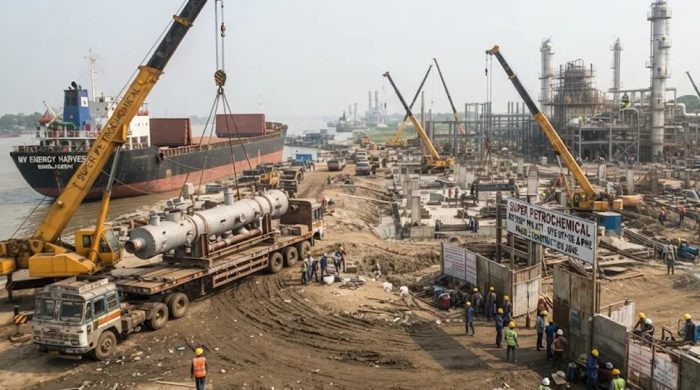
The immediate flashpoint for potential allied action is the arrival of the end-of-life vessel Maymei.
Within six days of the tanker beaching on the shores of Sitakunda on May 22, the U.S. Department of the Treasury’s Office of Foreign Assets Control (OFAC) designated the vessel on its Specially Designated Nationals (SDN) list under Executive Order 13846. The reason was clear, the ship had been actively moving sanctioned Iranian petrochemicals across international waters.
In global shipping, ignorance is not a legal defense. Purchasing and attempting to dismantle a designated asset embedded in Tehran’s shadow logistics network crosses a distinct red line. Under secondary sanctions doctrines vigorously applied by Washington and watched closely by allied maritime jurisdictions, entities that provide commercial off-ramps or cash liquidation for sanctioned hulls routinely face sweeping designations, cutting them off from global maritime insurers, classification societies, and international clearinghouses.
Human Cost of the “Green Yard” Facade
Beyond maritime sanctions evasion, Showkat Ali’s operations trigger the exact human rights and corporate negligence thresholds that animate Global Magnitsky frameworks in the UK, Canada, and Australia.
Marketed domestically as modern, compliant “green” facilities, S N Corporation’s yards conceal a grim operational reality. Data documented by Human Rights Watch and the NGO Shipbreaking Platform links his facilities to more than 25 worker deaths and dozens of life-altering burn casualties over the last decade.
The September 7, 2024 explosion aboard the MT Suvarna Swarajya (Unit-2) was not an unavoidable industrial mishap; it was gross organizational failure. The tanker was maneuvered into territorial waters under a flag of convenience with its automatic identification system (AIS) transponders dark. Gas-cutting operations were greenlit on the back of a forged gas-free certification, triggering a blast that burned at least seven men alive.
By operating a shadow syndicate, procuring high-risk hulls through offshore cash buyers and offloading the deadliest manual scrapping onto vulnerable day-laborers, Showkat Ali has externalized human risk while consolidating outsized profits, insulated entirely by domestic non-enforcement.
The London Paper Trail and the Writ Mandate
The paper trail of unexplained capital ties this domestic negligence directly to foreign financial capitals. The UK’s National Crime Agency (NCA) previously flagged and froze roughly $25 million deposited at UBS London tied to Showkat Ali, after finding no legitimate business origin for the wealth.
While that provisional freeze lapsed amid protracted institutional delay back home, the matter refused to stay buried. Following a public interest writ petition brought before the High Court, the bench stepped in with a strict directive, ordering the Anti-Corruption Commission (ACC) to formally expedite and resolve the money laundering probe. Layered onto that is a staggering penalty of over Tk 307 crore slapped on him by the National Board of Revenue (NBR) for unauthorized capital flight and offshore shell games.
For the financial intelligence units of the UK, the U.S., and their Commonwealth allies, an unexplained multi-million-dollar war chest in a London private bank combined with documented tax evasion at home paints a textbook picture of transnational money laundering.
Collapsing Political Armour and Capital Charges
For years, deep political patronage buffered Showkat Ali against meaningful legal consequence. That institutional shield fell apart in the wake of the July uprising. He stands formally indicted as the 54th accused, alongside deposed Prime Minister Sheikh Hasina, in a murder case filed under Section 302 of the Penal Code for the fatal shooting of madrasa teacher Hafez Md. Masudur Rahman on Badda Link Road. His father was the first President of Chittagong Bangladesh Awami League after the liberation war of Bangladesh.
Despite facing capital charges tied to state violence during the clampdown, he avoided arrest, skipped formal bail proceedings, and continued conducting high-value commercial transactions. For Western analytical desks tracking how illicit oligarchic wealth finances or props up authoritarian regimes, this convergence of political complicity and capital flight forms the backbone of human rights accountability dossiers.
Coordinated Retribution: The Five Eyes Factor
When secondary sanctions strike, they rarely land in isolation anymore. Regulatory actions initiated by OFAC for sanctions evasion frequently cross-pollinate with the UK’s Office of Financial Sanctions Implementation (OFSI) and Australia’s autonomous sanctions regimes.
Showkat Ali’s record checks three distinct boxes for coordinated allied intervention: 1) Materially transacting with sanctioned foreign energy assets (Maymei), 2) Egregious, recurring labor deaths shielded by domestic impunity (Magnitsky human rights violations), 3) Large-scale illicit transfers routed through major Western financial centers (NCA and High Court writ proceedings).
The protective silos that once shielded industrial tycoons from the reach of international law have broken down. With an NBR penalty on record, a court-mandated money-laundering inquiry underway, and a direct paper link to an OFAC-sanctioned tanker, the evidentiary dossier is complete. If the hammer falls, it will not just shut down an individual; it will freeze his bank lines, seize offshore assets, and bar his corporate footprint across the Western financial world.