The Election Commission’s mock voting exercise exposes a serious bottleneck.
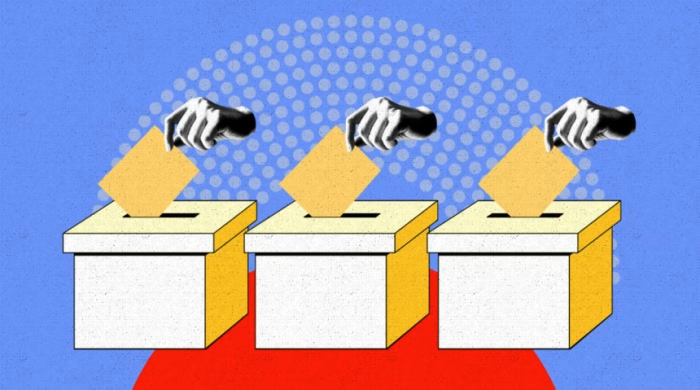
As Election Commissioner Abul Fazal Md Sanaullah, a former brigadier general, remarked, this bottleneck will pose a serious logistical challenge in the upcoming polls. It will be the first time in Bangladesh that voters cast two votes — one for their MP and another for the referendum.
Both elections are high stakes. One signals Bangladesh’s transition back to democracy while the other will decide the future of reforms aimed at strengthening democratic institutions.
Referring to the mock exercise of November 29, Sanaullah said everyone needed to be more conscious about time since there will be two votes. “It was seen that a voter takes an average of 3 minutes 52 seconds to cast the two votes. Those who vote without reading the ballot take 2 minutes, and those who read the ballot are taking 7 to 8 minutes.”
The longer duration is understandable.
The referendum question contains roughly 185 words, dense with legal and constitutional jargon covering four points.
Even for an educated voter, the referendum ballot is not an easy or quick read. The text alone can take up to two minutes to absorb. Then one needs to factor in the time needed to make a decision and mark their choice.
The challenge lies not only in the length of the ballot but also in its complexity. Familiarity with the subject matter plays a decisive role: those well-versed in constitutional reforms may move through the text more swiftly, while others encountering the proposals for the first time will naturally take longer.
The EC measures voting time from the moment a voter enters the polling booth — verifying their name on the voter list, collecting the ballot, moving into the private cubicle, marking and sealing the ballot, inserting it in the ballot box, and finally exiting the booth.
The election office has already finalised its plan for the upcoming national election with 42,761 polling centres and 244,739 booths across the country. Each centre will serve about 3,000 voters, with one booth for every 600 male voters or 500 female voters.
Voting was initially set to run for eight hours, from 8:00am to 4:00pm. It has now been extended by one more hour — from 7:30am to 4:30pm. Anyone already inside the station after 4:30pm will still be allowed to cast their vote, but no new voters will be admitted once the doors close. The election authority is also set to add more private cubicles wherever possible.
Now let us break down what this means at the polling booths. There will be about 600 men per booth and 500 women per booth. Each male voter would then get 54 seconds, and each female voter would get 65 seconds. But the mock showed each voter required far longer — 7 to 8 minutes (420 – 480 seconds) — which is eight times more than what the Election Commission’s arrangements currently allow. This will mean a large number of voters deprived of their franchise, while others will simply give up waiting and go home frustrated. Neither outcome is desirable.
If we look at local government elections — where voters cast three ballots — booths are set up for fewer people, giving male voters about 72 seconds and female voters about 82 seconds. But in those elections, voters are familiar with the format and symbols and often aware of what to expect — unlike with the referendum, about which there is far less awareness.
Predictably, it will take longer per voter in the upcoming election, and this will pose a challenge. Standing in line for hours can discourage participation, especially among women, elderly citizens, and those with health issues. Some voters may simply leave without casting their ballots, reducing turnout and weakening the legitimacy of the election. Slow-moving queues also fuel speculation about irregularities, creating mistrust in the process.
Even if the number of centres cannot be expanded, increasing the number of booths as well as cubicles would help reduce the load per booth and prevent long, slow-moving queues. That’s why voter education is crucial. The EC should launch immediate awareness efforts, including simple explainers on how to cast votes on two ballots. Sample referendum ballots can be distributed online and via mobile apps, and there can be campaigns in rural areas to familiarise first-time and elderly voters. Clear, accessible instructions on what the referendum proposals mean would help voters understand what to expect. This could be backed up by mock voting exercises at universities, colleges, and community organisations.
Familiarity makes a huge difference. Voters who understand the ballot beforehand will hesitate less and read faster. Reading speed depends on education, age, and the complexity of the content — but preparation builds confidence and efficiency.
The more informed citizens are before stepping into the booth, the smoother the voting process will be.