Inquiry commission says sections in admin, police, EC, intelligence agencies implemented the plans
The last three national elections were orchestrated at the highest levels of the state, with segments of the administration, police, Election Commission, and intelligence agencies mobilised to implement the plans, the inquiry commission on those polls said.
In a report submitted to Chief Adviser Prof Muhammad Yunus yesterday, the National Election (2014, 2018, 2024) Investigation Commission also noted that during those elections, control of the electoral process moved away from the EC to the administration.
The administration, not the Election Commission, became the driving force behind election management,” said the commission, which investigated allegations of corruption, irregularities, and criminal activities during those polls.
Image
It recommended widening the probe to include the 2008 election and urged legal action against those found responsible.
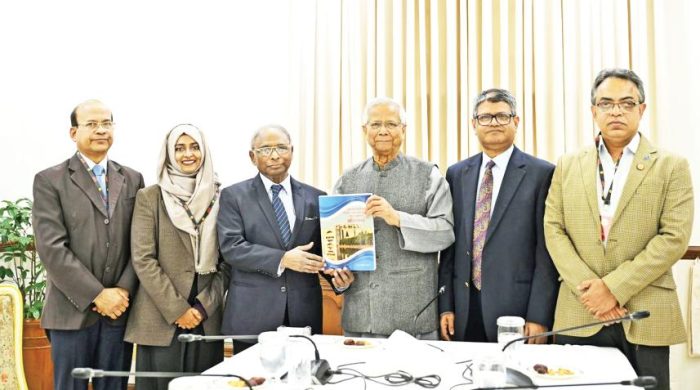
The five-member commission, led by Justice Shamim Hasnain, handed over the report to Prof Yunus at the State Guest House Jamuna in the afternoon.
After receiving it, the chief adviser said, “We had heard about vote rigging, we knew some of it. But the way the entire process was shamelessly distorted, the system twisted and crushed, and a verdict written on paper as they pleased… this [report] must be placed before the nation. A full record must be kept.”
Adding that the entire nation was punished in the name of elections organised with people’s money, he said, adding, “The people of this country looked on helplessly. They could do nothing.
“To give the people some relief, the faces of all those involved must be brought to light. We must know who did it, how they did it. And we must ensure that such election theft never happens again.”
Other members of the commission, formed on June 25 last year, are Shamim Al Mamun, former additional secretary; Kazi Mahfuzul Haque (Supan), associate professor of law at Dhaka University; lawyer Tajriyaan Akram Hussain; and election expert Abdul Alim.
The report said that in 2014, elections in 153 constituencies were uncontested, while the remaining 147 were staged as “competitive” but were entirely arranged and pre-planned. “This arrangement was made at the highest level of the state to keep the Awami League in power,” it said.
As the 2014 election was widely criticised globally as an uncontested one, the Sheikh Hasina-led Awami League adopted a mission to make the 2018 election appear “competitive”. The BNP and other opposition parties failed to grasp the far-reaching nature of this plan and participated in the polls.
According to the commission’s estimates, the 2018 polls saw overnight ballot stamping in 80 percent of voting centres to secure the Awami League’s victory.
“Within the administration, there was a form of dishonest competition to ensure the party’s win, resulting in voter turnout figures exceeding 100 percent in some centres.”
In 2024, as the BNP and other opposition parties did not participate, dummy candidates were fielded as a deceptive tactic to project competition in the election.
Since several thousand officials and employees were involved in irregularities across the three elections, and the time allocated to the inquiry commission was insufficient, it was not possible to identify all individuals or determine their specific roles, the report said.
At a press conference yesterday evening, chief of the commission Justice Shamim Hasnain said the master plan for the three elections was drawn up immediately after the 2008 polls.
The caretaker government system was formally abolished in 2011 through the 15th Amendment to the Constitution, as part of a broader, long-term strategy. The ruling party viewed the system as a major obstacle to retaining power at will, he added.
“It [ruling party] selectively appointed loyal individuals while forming the Election Commission. The commission did not exercise independent judgment but followed bureaucratic guidance during elections.
“Many capable BCS officers were available, but they were sidelined, and only a few loyal officers were assigned electoral duties.”
LESS TIME, INSUFFICIENT INFO
The report said that considering the scope of the investigation, the commission would have required at least a full year to complete its work. “Given the four-month time limit, it was not possible to conduct the investigation as extensively as planned.”
Meanwhile, a lack of necessary information also hindered the process.
After the 2014 parliamentary election, the EC Secretariat was moved from the Planning Commission campus to its own building in Agargaon, during which most 2014 election documents and related records were destroyed.
Additionally, due to weak documentation practices within the EC, not all information and documents required for the probe were available.
Since many people involved in the election process, including candidates, were absconding after the July uprising, it was also not possible to hold hearings with them.
“For the institutionalisation of democracy, it is necessary to conduct a detailed inquiry into the irregularities of the 2014, 2018, and 2024 national elections, including the ninth parliamentary election of 2008, and to take legal action against those responsible,” the report said.
ACTS THAT MARRED THE POLLS
The inquiry committee identified a series of actions that undermined electoral integrity, including the abolition of the caretaker government system and the use of selected parts of state intelligence agencies and the armed forces in shaping electoral strategies.
Other actions included restricting media workers from entering polling centres and filing false cases to harass opposition candidates and activists, many of whom were arrested, subjected to enforced disappearances under false, non-bailable charges, intimidated, or lured into withdrawing their candidacy.
The commission also noted widespread electoral fraud, including casting fake votes, using the executive branch to manipulate results, pre-filling ballot boxes, altering voter turnout figures, and destroying election-related documents and data after voting.
Voters were intimidated, and attempts were made to create splits within opposition alliances.
RECOMMENDATIONS
The commission recommended the formation of a new law for the appointment of election commissioners and cautioned that while a permanent Election Investigation Commission may be formed, it must not undermine the independence of the Election Commission.
It called for an independent and separate delimitation commission with full authority over boundary demarcation, and said parties registered before the 2014 and 2018 polls must be re-examined for transparency.
“Laws must be amended to keep intelligence agencies away from party registration activities. Legal provisions must prevent courts from halting registration processes.
“Intelligence agencies must be barred from involvement in election activities, though the Election Commission may seek their assistance strictly for security purposes, if necessary.”
It added, “It is essential to bring transparency to the activities of all intelligence agencies so that they cannot be used in the future as instruments for retaining state power.”
The report further said that no officer from the administration cadre should be appointed on deputation to the EC Secretariat. Returning and assistant returning officers should primarily be appointed from the commission’s own officials. If insufficient, appointments may be made from other cadres, including the administration.
Journalists with valid Election Commission cards should be allowed direct entry into polling centres without additional permission, it said, adding that they may collect information, take photos, and record videos without permission, though they cannot film inside voting booths unless irregularities occur.