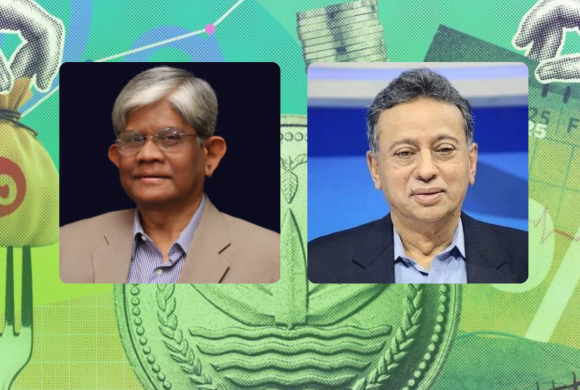
Bangladesh has entered a new political chapter. The interim government has stepped down, and with it, Salehuddin Ahmed as finance adviser. But on his way out, Ahmed left behind a detailed successor note for the new Finance Minister Amir Khosru Mahmud Chowdhury of the BNP-led government, outlining 20 priority tasks he believes deserve urgent attention.The gesture reflects just how much unfinished business remains. The new government inherits an economy under considerable stress. Inflation remains stubbornly high, the debt burden is rising, the banking sector is still fragile, and the tax system needs continued deep reforms. The question now is where to begin.Ahmed’s note offers a starting point– inflation.Bangladesh’s overall inflation has stayed above 9 percent since March 2023, and while it has eased slightly in recent months, the annual average stood at 8.58 percent in January, according to the Bangladesh Bureau of Statistics.Ahmed calls for tightly coordinated fiscal and monetary policy, better market monitoring, easing supply-side bottlenecks, and more careful management of essential imports.
Close behind inflation is tax reform.
As part of an ongoing overhaul of the National Board of Revenue, it is necessary to complete establishing the Revenue Policy Division and the Revenue Management Division, Ahmed said.It is also essential to introduce VAT automation and e-invoicing, digitalise the income tax system, modernise customs administration, and review tax exemptions, he argued, adding that expanding the tax base and preventing tax evasion are also crucial.
The tax reform report prepared by the task force must be reviewed and implemented, he said.On the external front, he noted that foreign exchange reserves and debt management demand careful handling.
Bangladesh repaid $4.11 billion in external loans in fiscal year 2024-25 (FY25), and the target for FY26 is $4.83 billion.
Ahmed urges maintaining a market-based exchange rate, providing incentives to channel remittances through formal mechanisms, strengthening export performance and external debt management to bolster foreign exchange reserves.
Avoiding non-concessional loans as much as possible is crucial, especially as Bangladesh’s debt risk rating has been downgraded from “low” to “moderate.”
Regarding the budget deficit and financing, the former adviser notes that although the deficit remains below 5 percent of GDP, the debt-to-GDP ratio has been rising steadily.
Since the stock of external debt and the amount of principal and interest payments are not aligned with export earnings or revenue income, the government’s debt-carrying capacity has weakened.
Although, according to the International Monetary Fund’s benchmark, debt sustainability remains at a tolerable level, caution is necessary.
Meanwhile, one of the more politically sensitive items on the list is a new government pay scale.
The former adviser notes that it has been nearly 11 years since civil servants last received a pay revision in 2015, and cumulative inflation of around 111 percent since then has significantly eroded their real incomes.
The Ninth National Pay Commission has recommended wages up to 142 percent higher, which would require an additional Tk 1.06 lakh crore annually.
Economists have raised alarms about the fiscal burden, but Ahmed maintains that implementing a new pay scale is necessary to preserve the living standards of public servants.
The financial sector also looms large. Key legislative work remains pending, including the Bank Company (Amendment) Ordinance 2026, the Bangladesh Bank (Amendment) Order 2026, the Distressed Asset Management Ordinance and amendments to the Money Laundering Act.
In October last year, central bank Governor Ahsan H Mansur sent a letter to the finance adviser requesting a legal overhaul of the 1972 Order. He sought greater autonomy for the central bank, aligning it with global standards and shielding the institution from political influence.
The interim government chose to pass the Bangladesh Bank autonomy reform plan to the next elected government rather than enact it directly, leaving that task now squarely on Khosru’s desk.
Bank consolidation, capital market regulation, and broader governance reforms in the financial sector round out the agenda.
Ahmed flags the slow pace of foreign aid disbursement as a persistent drag.
He recommends regular coordination meetings among the Economic Relations Division, line ministries, and development partners, with lagging projects placed under special monitoring.
Strict compliance with project preparation requirements and loan agreement conditions is essential, with priority given to infrastructure, education, health, and social protection sectors.
For expenditure rationalisation, greater focus should be placed on high-priority development projects. Energy, agriculture, and food subsidies need to be better targeted, and although the coverage of social protection programmes has expanded, their efficiency must be improved.