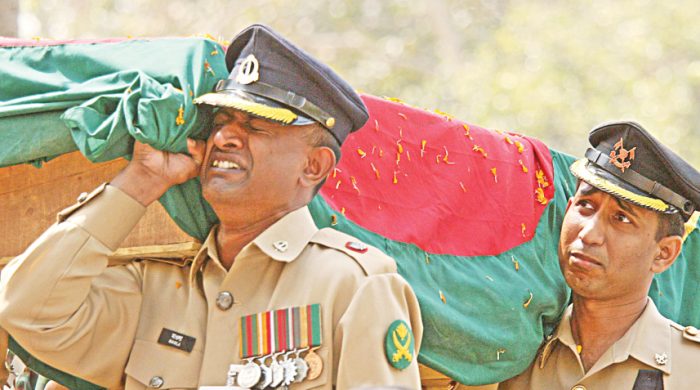
For 17 years, the killing of 74 people, including 57 of the nation’s top military officers, during a mutiny at the then BDR headquarters in Pilkhana has remained an open wound, clouded by state-led investigations dismissed by critics as a facade of justice.
In 2024, the Ministry of Home Affairs set up a seven-member body to re-examine the findings of the 2009 BDR mutiny commission, following widespread criticism of the 2013 mass trial. The inquiry was tasked with uncovering evidence that the previous report may have overlooked due to political interference.
The previous official investigation into the mutiny blamed years of pent-up anger among ordinary soldiers, who felt their appeals for pay raises and better treatment were ignored. Rampaging troops from the then Bangladesh Rifles (now Border Guard Bangladesh) murdered some of the brightest military officers during the two-day revolt that began in Dhaka’s Pilkhana on February 25, 2009 and spread across the country.
However, the new body, the National Independent Investigation Commission, which submitted its final report in November 2025, contradicts the findings and said the massacre had direct involvement of the then-ruling Awami League leadership. It specifically named lawmaker Sheikh Fazle Noor Taposh, former defence and security adviser to the prime minister Tarique Ahmed Siddique, and former army chief General Moeen U Ahmed, among others.
The report, submitted to former chief adviser Prof Muhammad Yunus, has not been made public, and details of the evidence against the accused have not been disclosed.
The Daily Star has seen the report, which gathered evidence against some of the top civil and military officials as well as politicians.
Meanwhile, on February 23, the newly formed BNP government announced that it would constitute another commission to reinvestigate the incident to ensure justice.
EVIDENCE AGAINST TARIQUE SIDDIQUE, MOEEN U AHMED
In the latest report, the most substantial evidence against Tarique Ahmed Siddique and General Moeen U Ahmed comes from the testimony of Chief of Army Staff General Waker-Uz-Zaman, who was present at the scene on the day of the mutiny.
Waker, then a major and second-in-command of the 17th East Bengal Regiment, arrived at the scene around 10:30am. He positioned troops from the 46th Independent Infantry Brigade near Gate 4 of the BDR headquarters and was prepared to intervene.
According to Lt Gen (retd) Abdul Mubeen, then the principal staff officer of the Armed Forces Division, he instructed Waker to take position on the rooftop of a building in Dhanmondi near the Pilkhana gate and fire several rocket shells targeting the gate.
Mubeen said Tarique later ordered him not to intervene. Tarique subsequently confronted Mubeen and questioned whether he had the authority to order such a move. Mubeen later became the Chief of army staff.
According to the report, Waker, unable to reach the commander of the 46th Brigade for orders, contacted Major General Tarique Siddique. The report says Tarique bypassed the chain of command and explicitly instructed him not to launch an attack, citing the government’s decision to pursue a political resolution.
According to the report, Tarique was alerted to the massacre as early as 9:37am, when Major Md Zaedi Ahsan Habib, who was trapped in the Darbar Hall as the killings unfolded, called him seeking help. Tarique had previously been Zaedi’s commanding officer. Zaedi survived and later testified before the Commission.
In his testimony, Maj Gen Rezanur Rahman Khan, additional director general (operations) of RAB, then a colonel, told the Commission that he received news of the mutiny around 9:30am from BDR officers and set out for Pilkhana with his forces.He said he had already ordered RAB-2, RAB-3 and RAB-10 to proceed to Pilkhana and had authorised them to open fire if necessary.
On the way, Tarique called and instructed him to go instead to the state guest house Jamuna. Upon arrival, the then director general of RAB told him to cancel the order to fire and advised him to contact the appropriate authorities regarding army deployment.
Rezanur said he was also instructed by the then DG of the Special Security Force, Brig Gen Joynal Abedin, and by Tarique not to intervene. He relayed those instructions to his forces on the ground.
According to his statement, he repeatedly sought permission to enter Pilkhana with RAB personnel but was not approved.
The report further said that on the morning of 27 February, when Brig Gen Abdul Hakim Aziz, then the director of Military Operations (DMO) at the Army Headquarters, entered Pilkhana in an armoured personnel carrier, Tarique allegedly verbally reprimanded him for bringing the vehicle inside.
It also says that on the evening of 25 February 2009, Major General Sultanuzzaman Saleh — then brigadier general at the Directorate General of Forces Intelligence (DGFI) — went to the National Monitoring Centre (NMC) to conduct mobile phone monitoring under Tarique’s instruction, bypassing the chain of command.
The Commission noted that because Sultanuzzaman monitored networks for an extended period without valid authorisation and outside his regular duties, the possibility that he was identifying officers’ locations and relaying the information to the mutineers could not be ruled out.
National Monitoring Cell (NMC) chief Brig Gen Md Khorshed Alam told the Commission that Saleh barged into the NMC and took over. NMC was the predecessor of the NTMC and was located inside the DGFI premises.
In his interview with the Commission, General Moeen U Ahmed, then the army chief, said he attended an emergency cabinet meeting at the prime minister’s residence, Jamuna, and was tasked with overseeing the military response.
The Commission found that the army chief failed in his duty to protect his officers by not issuing specific operational orders to the 46th Independent Infantry Brigade and instead spending critical hours at Jamuna.
Despite reports of officer fatalities by noon, the report says he supported political negotiations and ordered troops to withdraw to a position two miles away, a move that allegedly allowed the attackers to continue the killings and later escape.
EVIDENCE AGAINST TAPOSH AND SHEIKH SELIM
The Commission called Barrister Sheikh Fazle Noor Taposh a key coordinator of the massacre.
One premise of this accusation is that Taposh had a close acquaintance with some of the sepoys and jawans convicted as primary conspirators of the BDR mutiny.
Sepoy Selim Reza, currently incarcerated, told the Commission that ahead of the 2008 general election, Taposh met several BDR personnel to discuss their grievances. The group was brought to him by Torab Ali, a ward-level Awami League leader in Dhaka.
Torab Ali later died in jail after being accused and convicted in the 2009 BDR carnage case, though he was subsequently acquitted of conspiracy charges.
Another incarcerated BDR member, Nayek Sheikh Shahidur Rahman, who was close to Torab, told the Commission that Torab had described a secret planning meeting at Taposh’s residence. He claimed those present included former lawmakers Sheikh Selim, Jahangir Kabir Nanak and Mirza Azam, Torab Ali, along with mutiny leaders likeSepoy Milon.
Rahman said Torab objected to a plan to kill officers but was overruled by Sheikh Selim. Shahidur Rahman is the sole source for this alleged meeting.
According to the report, a sweeper, Abdul Hakim, also witnessed Taposh holding meetings with jawaans and BDR’s deputy assistant director Syed Tauhidul Islam on three occasions.
DAD Tauhid, who was sentenced to death in the BDR carnage, was named in the report as a key coordinator.
On February 25, 2009, DAD Tawhid led a 14-member rebel delegation to the then prime minister’s residence (Jamuna) to negotiate a surrender and seek a general amnesty for the mutineers. The report also notes that during the two-day massacre, Tawhid maintained command over the rebel factions.
Sepoy Selim Reza (now incarcerated), who was present at the meeting, said that Hasina had promised to make DAD Tawhid the director-general of BDR.
Major Sumon Ahmed of the 4th East Bengal Regiment told the Commission that during the mutiny, he saw Taposh, former police inspector general Nur Mohammed, Nanak, and Mirza Azam enter and exit the BDR HQ several times without hindrance, while others, including the army, were barred. He also said that around 11:30am, he saw Taposh distributing leaflets to the jawaans.
Around midnight of the day of the mutiny, Taposh, former home minister Sahara Khatun, and the then IGP held a meeting with the mutinous jawaans. Subedar Major Gofran, an eyewitness, said Sahara asked the jawans whether they wanted Taposh or Nur Mohammed as director-general.
The events following the mutiny brought further scrutiny to Taposh.
Five military officers who had been on duty during the mutiny, took action against the rebels, or were involved in post-event investigations, were forcibly disappeared, tortured in a joint interrogation cell, and imprisoned for five years through a court-martial.
They were accused of attempting to assassinate Taposh with a remotely controlled bomb on 21 October 2009, outside his law office in Motijheel. The officers named in the case were Major Helal, Capt Rezaul Karim, Capt Khondokar Rajib Hossain, Capt Md Fuad Khan, and Capt Subayel Ibne Rafique.
The Commission noted that all five were at their respective stations on the day of the attack and could not have been involved.
According to the report, Capt Rezaul had fired at rebels during the mutiny and later received a stand-down release for disobeying the army chief’s order. Fuad had defied orders to keep the army out, seized weapons from the armoury, and launched a rescue operation into Pilkhana on 26 February to save surviving officers. Subayel had acted similarly, taking arms from the 14th Engineering Brigade to aid the rescue.
Capt Rezaul told the Commission that they were forcibly disappeared and framed to remove them from the investigation and destroy the evidence they had gathered. All five said they were tortured in the “Aynaghar”-famed Joint Interrogation Cell (JIC). Brigadier General Imamul Huda, who headed the court-martial, admitted that the officers appeared physically abused during their hearings.
The initial investigation could not prove the allegations. Yet, after the court-martial, the officers were taken to the AIC, tortured again, and forced to give confessional statements under duress. They told the Commission that Brig Gen Huda threatened them with prolonged torture if they did not sign a blank paper.
The Commission’s review of the court-martial proceedings found gross discrepancies, indicating the officers had been deliberately framed.