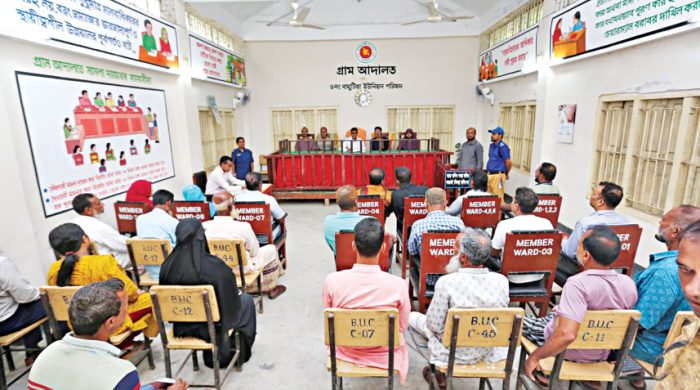
Village courts offering low-cost legal remedies to rural population as formal judiciary grapples with backlogs
Forty-year-old Nazma Begum, a garment worker, found herself in a precarious situation after her husband, Asad Mia, verbally divorced her and forced her out of their home.Left without financial security or support, she struggled to provide for herself.Fearful of the cost, delays, and social stigma associated with the formal justice system, Nazma avoided police stations and district courts.On a neighbour’s advice, she filed a claim with the Village Court of Belabo Union Parishad in Narsingdi for eight months’ unpaid maintenance allowance on December 1, 2024, paying a fee of only Tk 20.Her case was resolved within a week, without the involvement of a lawyer.
“All I had to do was appear on a single day,” she told this correspondent.
Her husband eventually paid Tk 65,000, which was disbursed to her through the UP chairman.
Nazma’s case was one of many minor disputes that village courts resolved, sparing litigants the need to turn to the formal justice system. More than 4.63 million cases were pending with courts across the country as of March, according to a Supreme Court study published in July.
To access this local justice, an applicant has to collect and fill out a form at the Union Parishad Office and submit it to the chairman, paying a fee of Tk 10 for a criminal complaint or Tk 20 for a civil case.A criminal complaint must be filed within 30 days of the incident, while a civil dispute must be lodged within 60 days of the incident or within a year in cases of land dispossession.
Once filed, the court is constituted with a five-member panel comprising the UP chairman and two representatives nominated by each party.
Hearings follow an “open justice” practice where decisions are made without lawyers’ involvement. If the UP chairman is absent, a panel chairman or UP member steps in, while women’s representation is mandatory for panels handling disputes involving women’s issues or interests.
JUSTICE WITHIN REACH
Established under the Village Court Ordinance 1976 and governed by the Village Court Act 2006, village courts have long been trying to win public confidence.
With support from the European Union and UNDP, the Local Government Division (LGD) is implementing Phase III of the Activating Village Courts in Bangladesh (AVCB) project, expanding the system to 4,456 union parishads — 3,048 newly activated and 1,408 already supported — across 61 districts.
A 2024 amendment to the Act expanded the courts’ pecuniary jurisdiction to Tk 300,000 and brought maintenance claims by wives within their remit.
Village courts handle specified civil and minor criminal disputes, including claims involving debt, land dispossession, agricultural wages, crop or livestock damage, and maintenance, as well as offences such as theft and trespass.
Serious crimes, including murder, rape, kidnapping, and robbery, remain under the formal justice system.
A 2025 UNDP-supported evaluation found that each plaintiff spent an average of Tk 328 — including fees, transport, food, and other expenses — to resolve a dispute through a village court, compared with Tk 8,670 through the formal court system.
“Exclusion of lawyers keeps costs low and prevents minor issues such as livestock theft or small debt claims from forcing rural families to sell assets just to litigate,” said Advocate Borkot Ali, legal director of Bangladesh Legal Aid and Services Trust (BLAST).In some instances, cases filed with district courts are being sent back to union parishads to be settled through village courts.
Afia Khatun, 73, experienced this first-hand.
She went to police on September 8 last year after being assaulted by her daughter over a dispute involving Tk 100,000 from the sale of inherited land. Her case reached the Chief Judicial Magistrate’s Court in Narsingdi on October 12.
After remaining in the formal system for nearly eight months, the case was transferred to Bajnabo Union Parishad in Narsingdi for local adjudication.
The UP registered the case on April 9 this year, constituted a panel, and resolved the dispute on April 27 — just 18 days after the referral.
“I could have saved both time and money if I had gone straight to the village court,” Afia told this correspondent.
Between February 2024 and July 2026, district courts referred at least 22,698 cases to village courts.
A 2025 UNDP study found that 61 percent of these cases were resolved through village courts. Another 31 percent were dismissed because applicants did not appear, while 8 percent remained pending when the study was conducted.
According to AVCB project data, 268,328 cases were recorded by village courts nationwide during the period. Of those, 74,458 were filed by women, demonstrating strong community reliance.
The overall resolution rate was 83.77 percent, with an average of 18 days taken to dispose of each case.
For Surayya Akhtar Jahan, additional secretary at the LGD and national project director of AVCB Phase III, the significance of village courts goes beyond the number of cases resolved.
“If these minor disputes were left unaddressed, many could escalate into more serious social conflicts,” she said.
A village court’s decision is considered executed only when all parts of it have been fulfilled — such as when compensation is paid, property returned or land restored.
If ordered compensation remains unpaid, the UP chairman can recover it using the same method used for recovering outstanding UP taxes. If recovery fails, the matter can be referred to the Upazila Nirbahi Officer as a public demand.
To address bias or local political clout, the Act allows litigants to apply to the UNO to change the panel chief.
A 2025 Court User Survey shows that 95 percent of respondents considered UP chairmen to be neutral, and 92 percent saw decision-making as transparent. However, 6 percent said decisions were influenced by local influential people or political leaders, while another 6 percent reported nepotism or favouritism.
Khairul said the system has reduced one-sided influence compared with traditional village arbitration.
“Political or one-sided influence has reduced noticeably because both parties nominate their own panel members,” he said.
Surayya said that as the donor-supported intervention winds down, the LGD is seeking to shift operational, capacity-building, and digital-maintenance costs into the government’s core revenue budget under an Exit and Sustainability Plan.The project also aims for full digital coverage across 4,456 union parishads by this year, while LGD has proposed recruiting two women as members of the village police in every UP to assist women litigants.
The test now is whether a donor-supported project can become a durable, state-owned part of Bangladesh’s justice architecture.
For someone like Nazma, who couldn’t afford a lawyer or frequent travel to a district court, the village court was a source of immediate remedy. All she needed to do was approach the UP, and within a week, her problem was resolved before it could become another case in Bangladesh’s already burdened court system.