Special Correspondent:
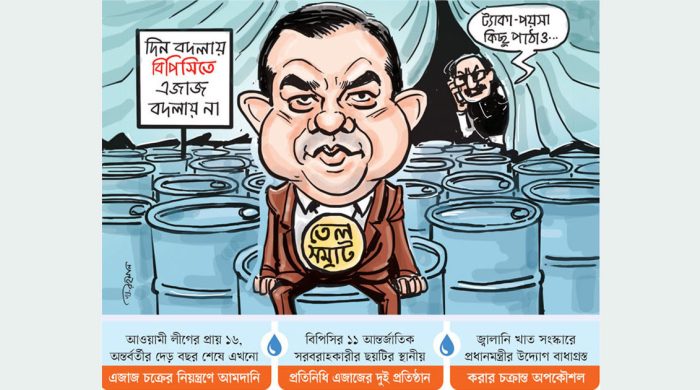
The government has changed, and so has the policymaking structure in the energy sector. Yet allegations persist that a long-standing business network continues to wield significant influence over fuel imports by the Bangladesh Petroleum Corporation (BPC).
An analysis of BPC tender documents, work orders and related records shows that the local representation of several international fuel suppliers is linked to the same business group. A significant portion of BPC’s refined petroleum imports for the 2025–26 fiscal year has also reportedly been awarded to companies associated with this network.
The development has raised fresh questions about competition in fuel procurement, security of supply and the potential risk of additional costs to the government.
For years, allegations have circulated about the influence of a particular business network in Bangladesh’s energy sector. Several industry insiders claim that business relationships developed during the long tenure of the Awami League government have not been completely dismantled following the change in government.
An analysis of BPC records, tenders and work orders found that at least six of the 11 international companies listed as suppliers of refined petroleum products have local representation or business links with two companies owned by Dr Ejazur Rahman — Seven Mark and TransBangla Commodities Ltd.
Among the international companies associated with Seven Mark are Uniprec Singapore Pte Ltd and Indonesia’s PT Bumi Siak Pusako (BSP)-JAPIN. Meanwhile, Petco Trading Labuan Company Ltd, PTT International Trading, Vitol Asia and Sinochem International Oil have been identified as companies linked to TransBangla Commodities.
In other words, although the international suppliers are separate entities, a significant portion of their local representation in Bangladesh appears to be connected to the same business network, according to the findings.
According to BPC data, work orders were issued for around 5.51 million tonnes of refined petroleum products in the 2025–26 fiscal year through government-to-government (G2G) arrangements and open tenders.
Of this amount, around 4.3 million tonnes went to companies whose local representatives or business connections are reportedly linked to firms associated with Ejazur Rahman. This represents approximately 78 per cent of the total volume covered by the work orders.
The volume of work orders alone, however, does not establish any irregularity. International fuel procurement takes into account a range of factors, including price, product quality, supply capacity, previous performance and tender conditions.
The central concern is therefore not simply the volume of business awarded to these suppliers, but whether adequate competition exists and whether excessive dependence on a limited number of suppliers creates additional risks.
A review of tender documents for the June–August period shows that BPC initiated procurement of between 925,000 and 1.15 million tonnes of refined petroleum products through four packages.
Under Package PG-1, Uniprec Singapore received the work order to supply between 320,000 and 390,000 tonnes of diesel and 70,000 to 90,000 tonnes of jet fuel.
Under PG-2, Vitol Asia received the work order for 300,000 to 340,000 tonnes of diesel and 60,000 to 80,000 tonnes of jet fuel.
Trafigura received the work order under PG-3 for 150,000 to 200,000 tonnes of furnace oil. Under PG-4, Vitol Asia received the order to supply 25,000 to 50,000 tonnes of octane.
According to the findings, the local representation of Uniprec and Vitol Asia — which secured contracts under three of the four packages — is linked to firms associated with Ejazur Rahman.
The potential total import cost under these packages exceeds Tk17,000 crore.
In fuel imports, suppliers’ premiums are determined after taking into account international benchmark prices, local transportation, insurance, freight and other risks.
The premiums quoted by some suppliers have risen significantly in recent tenders.
In open tenders for the January–June period of fiscal 2025–26, Uniprec secured orders at premiums of $4.72 per barrel for diesel and $6.86 for jet fuel. During the same period, Vitol Asia quoted premiums of $4.78 for diesel and $6.88 for jet fuel.
For the subsequent June–August period, Uniprec proposed premiums of $13.25 per barrel for diesel and $14.86 for jet fuel. Vitol Asia quoted $13.18 and $14.78 respectively.
BPC officials and people familiar with the procurement process say the rise in premiums was justified by the conflict in the Middle East and increased risks to international shipping.
However, questions remain over whether factors beyond global market conditions — including the number of available suppliers and the level of competition — also contributed to the increase.
Industry insiders say a comparative analysis of international and regional market prices against BPC’s procurement prices during the same period would be necessary to determine whether the premiums were reasonable.
BPC documents also indicate that during the recent escalation of tensions in the Middle East, two international suppliers with local representation linked to the Ejazur-associated business network informed BPC that they were unable to supply certain contracted fuel products.
The matter was also reportedly discussed in a meeting of the BPC board, according to sources familiar with the proceedings.
Energy sector experts say excessive dependence on a particular country or region can create supply risks, while dependence on a limited number of suppliers can pose similar problems during a crisis.
If several suppliers become unable to deliver at the same time, securing fuel quickly from alternative sources could become difficult, they said.
The involvement of former officials of BPC and state-owned oil marketing companies with firms associated with Ejazur Rahman has also emerged during the inquiry.
Sources claim that at least 10 former officials of BPC and oil marketing companies joined Ejazur’s businesses after retirement. They previously held responsibilities related to oil procurement and sales, marketing, international supply and administration.
Mustafa Qudrat-e-Elahi, a former managing director of Jamuna Oil Company, has also joined TransBangla Commodities, according to multiple sources.
The investigation also found that offices of Ejazur’s companies are located in the same building in Kawran Bazar, Dhaka, where BPC’s Dhaka liaison office is situated.
Taking a job with a private company after retirement is not, by itself, evidence of wrongdoing. However, industry insiders believe the issue warrants scrutiny because of the former officials’ previous responsibilities, their roles in the companies they later joined and the companies’ ongoing commercial dealings with BPC.
Questions have also been raised about Indonesia’s BSP-JAPIN, an international supplier with local representation linked to the Ejazur-associated network.
Some officials have questioned whether the company met BPC’s prescribed eligibility requirements when it was listed as a supplier under the G2G arrangement.
Records at Chattogram Port indicate that several consignments of fuel imported for BPC in the company’s name arrived from ports in Malaysia and Singapore rather than directly from Indonesia.
However, supplying goods through a third-country port does not, in itself, constitute evidence of wrongdoing. The key issue is whether the supplier met BPC’s eligibility criteria when it was enlisted and what supporting documents were submitted at the time.
Industry stakeholders believe that increasing the number of fuel supply sources and promoting greater competition could help reduce long-standing commercial dependencies.
They say BPC’s procurement process should be made more transparent, supplier eligibility should be reviewed regularly, and potential conflicts of interest involving local representatives should be examined carefully.
Prof M Shamsul Alam, energy adviser to the Consumers Association of Bangladesh (CAB), said that if an individual influences the tender process and interferes with competition, it is a serious matter.
“If specific evidence is found to substantiate the allegations, legal action should be taken against those responsible,” he said.