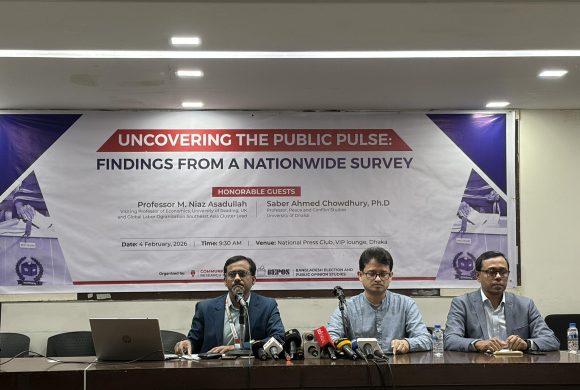
Former Awami League voters are showing a significant shift in political preference ahead of Bangladesh’s upcoming national election, with 48 percent now leaning towards the BNP, according to a new nationwide survey.
At the same time, 37.4 percent of voters who are voting for the first time since 2008 said they prefer Jamaat-e-Islami, the survey said.The survey also shows strong public interest in voting. More than 90 percent of voters said they want to cast their ballots in the upcoming election, while around eight percent said they are undecided or may not vote.
Titled “Uncovering the Public Pulse: A Nationwide Survey,” the findings were presented by Zakaria Palash, strategic coordinator of the Communication and Research Foundation, at the Jatiya Press Club in Dhaka this morning.The survey was jointly conducted by the Communication and Research Foundation and Bangladesh Election and Public Opinion Studies. It covered 11,038 voters across the country using stratified random sampling, with data collected in two phases between November 20 and December 31, 2025.
According to the survey, corruption has emerged as the most important issue for voters. About 67.3 percent of respondents identified corruption as their top concern, while only 35.9 percent mentioned religion as a key issue.
Despite Bangladesh being a Muslim-majority country, the survey suggests that identity and religious issues are less important to voters than governance, transparency and economic challenges.Voters across age groups and genders said they prefer leaders who care about ordinary people and can demonstrate strong and effective leadership. Personal charisma was seen as less important than empathy, accountability and the ability to govern.
Television and social media were identified as the most influential sources of political information. Most voters said they rely on multiple platforms rather than a single source, reflecting a growing mix of traditional and digital media consumption.The study also highlights concerns about election-day security. Voters expressed greater worry about safety at polling centres than about institutional arrangements. Fear of intimidation, vote rigging and ballot stuffing were common concerns among supporters of all political parties, although the level of concern varied.
The report further found that candidates matter more than parties for many voters. Nearly two-thirds of respondents said they consider candidates when deciding whom to vote for. Among them, 30.2 percent said they vote based only on the candidate, while 33.2 percent consider both the candidate and the party.