Hospital has suspended surgeries, lacks essential equipment and medicines, and forces poor families to seek costly alternatives
Rupa Khatun arrived at the Pabna Mother and Child Welfare Centre for a routine prenatal check-up during her second pregnancy. She left with only a prescription.There are no ultrasonography or essential testing facilities here,” said Rupa, who is four months pregnant.
Unable to afford private hospitals, where regular pregnancy check-ups can cost more than Tk 3,000, she has little choice but to rely on this government facility, where treatment is available at a minimal cost.Her first pregnancy ended in a caesarean section at another hospital because the centre could not provide the service. Now, she is preparing for the same outcome again.Meanwhile, Md Shahidul Islam brought his wife, who is six months pregnant, to the same hospital for a different reason: to keep her eligible for a government pregnancy allowance that his family depends on.
The government provides Tk 800 a month for 24 months to eligible pregnant women aged 20 to 35 from low-income families — those with a monthly income of less than Tk 2,000 — during their first or second pregnancy. To receive the allowance, they must obtain a pregnancy certificate from the district family planning office.
“I know the limitations of the hospital, but I still brought my wife here for the allowance,” Shahidul said.Established in 1964 and handed over to the Department of Family Planning in the 1980s, the 20-bed hospital is the only dedicated maternity facility in Pabna. But decades of neglect have left it struggling to provide even basic maternal healthcare.
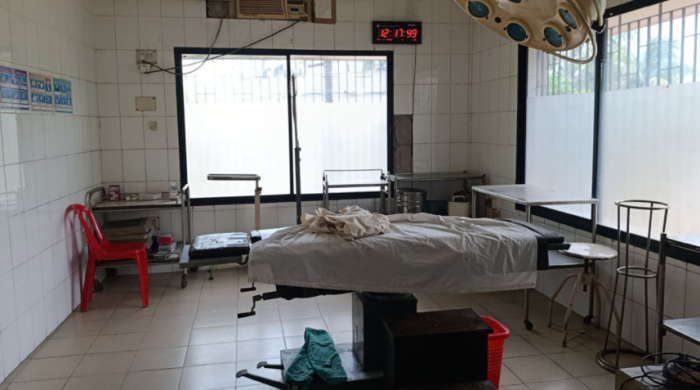
The operation theatre, for instance, has remained unused since January.“It has two surgical tables, but our anaesthesia machine is 40 years old and unreliable. We do not even have an anaesthetist, so surgeries have been suspended for the last six months,” said Dr Urmi Shaha, the hospital’s key medical officer.
Dr Shaha said she has to single-handedly manage all outdoor clinics alongside prenatal, delivery and postnatal care.
The hospital now handles only normal deliveries, and even those are under strain. “We have to manage five deliveries using only two kits,” she said, adding that no new funds or equipment had arrived in years.
Hospital records show 677 normal deliveries between July last year and May this year — roughly 61 a month — against just 12 caesarean sections performed late last year.
Although services are meant to be largely free, patients spend Tk 1,000 to Tk 1,500 out of pocket per delivery on medicines and supplies, said Amina Begum, a housewife from Dorivaudanga village.Pharmacist Md Kamrul Islam said there had been no supply of saline, surgical tools or medicines for the last two years. The hospital’s ambulance has remained grounded due to the lack of a fuel allocation, while the building itself was last repaired in 1992 and its wards now flood during heavy rain.
“We have repeatedly informed the higher authorities about our structural weaknesses, staff shortages and equipment shortages, but no initiatives have been taken,” Dr Shaha said.
ABM Shariful Haque, deputy director of the district family planning office, did not dispute the picture.
“This is the reality for most family planning hospitals across the country,” he said. “The higher authorities are aware and doing their best, but everything ultimately depends on fund approvals.”
Shariful Haque said the office regularly writes to the Directorate General of Family Planning seeking the recruitment of doctors and other staff, the supply of medicines and surgical equipment, and funds to repair the hospital and replace outdated machinery, but has yet to receive a positive response.