Election season generates short-lived money circulation, stretching from street corner tea stalls to the factories of large conglomerates.On the morning of January 29th, before the sun had fully risen over Rajshahi, food vendors began arriving at a local Madrasa field.They came with carts and baskets, setting up their makeshift stalls with practised efficiency. By the time the first group of political supporters started trickling in, the field was ringed with small shops selling bottled water, peanuts and pickles, sugarcane juice, yoghurt, and other local snacks.Tarique Rahman, chairman of the Bangladesh Nationalist Party (BNP), was scheduled to speak that afternoon. And the vendors knew what that meant: thousands of people, many of whom had travelled for hours, all of them hungry and thirsty.National flags and party banners fluttered overhead as vendors moved through the crowd selling caps and badges, T-shirts printed with the faces of BNP icons. The hotels nearby had been booked full. Many activists had arrived the night before and stayed in city lodgings. Others had set out before dawn, riding in hired buses or packed into CNG auto-rickshaws.Loudspeakers were set up across the field and nearby areas, while digital screens were installed so everyone could see the programme clearly.
Within hours, stalls at the ground ran out of bottled water. Throughout the day, the scene repeated itself — tea vendors pouring cup after cup, snack sellers scooping puffed rice into paper cones — the whole enterprise humming with energy.
This was not unique to Rajshahi. Across the country’s divisional cities, similar scenes unfolded in the fortnight leading up to the February 12 parliamentary election.
Banners hung over the streets. Rickshaws with loudspeakers moved through neighbourhoods, broadcasting messages that often came with rhythmic music.
In a country where some 2,000 candidates from roughly 50 political parties are competing for seats, the campaign season has become its own micro-economy, a temporary boom that enriched some and bypassed others.
THE WINNERS OF ELECTION SEASON
Sagir Ahmed has been in the microphone-rental business in Bancharampur, Brahmanbaria, for years, but he has never seen demand like this.
“I have to contact smaller mike service providers in the district to collect loudspeakers and supply them to candidates.”
His rates have doubled to Tk 1,000 per day, and still, every piece of equipment is booked.
Each candidate, he told The Daily Star, spends around Tk 3,000 daily per sound system, including the microphone, a motorised rickshaw and an announcer.There are roughly 100 microphone service providers in Ahmed’s district, and all of them are fully booked throughout the campaign season.
Tea vendors have also felt the election warmth. Political conversations take centre stage at tea stalls even in regular times. But during campaign season, it booms.
People gather at stalls not just to drink but to argue and debate the merits of candidates and parties.
For tea stall owners like Patuakhali’s Badal Hossain, it means longer hours and bigger profits.
Tea is the most popular beverage in Bangladesh. The country consumes nearly 9.5 crore kilogrammes of tea annually. During elections, consumption typically rises by 5 percent to 7 percent, according to industry officials.Badal said his daily sales have climbed from Tk 4,500-Tk 5,000 to as much as Tk 6,000.
Eleash Mridha, managing director of PRAN Group, one of the country’s largest food processors, has seen this pattern repeat itself election after election.
“Demand for fast-moving consumer goods rises by 20-25 percent during campaign season, driven especially by tea, biscuits, and puffed rice,” he said.
This year, tea and coffee sales have already increased, though soft drinks are yet to see a similar surge, he noted, adding that with warmer weather and greater public engagement expected next week, demand is likely to grow further.Meanwhile, Taslim Shahriar of Meghna Group of Industries, one of the leading commodity importers and processors, said traditionally demand for sugar and biscuits rises during national elections.
“This year, we have witnessed increased demand, especially for sugar. This may be because of the ensuing Ramadan and the election,” he said.
Meanwhile, restrictions on plastic banners and the emphasis on digital campaigning have shifted money elsewhere — to Facebook and YouTube advertisements, to TikTok promotions, to the kind of virtual presence that leaves no physical trace.
Many candidates have hired photographers, videographers and social media content creators, while supporters broadcast events live.
Money flows to hotels and transport operators too.WHEN REGULATIONS CUT DEMAND
But not all businesses are benefiting. Paper makers and printers are experiencing a sharp downturn because the Election Commission banned large posters for this election.
MM Nurun Nabi, executive director of Partex Paper Mills Ltd, said paper millers who registered increased business in the past elections see almost no spike in demand this year. Only leaflets are being printed.
“There had been a lot of activities in the past election. None of that is visible this time,” he said.
Md Anwar Hossain, vice chairman of Bangladesh Mudran Shilpa Samity, an association for local printers, said changes in campaign regulations and restrictions have sharply reduced demand for printed materials.
Candidates are spending only Tk 5 lakh to Tk 6 lakh on leaflets, about one-eighth of what was spent in previous elections, when candidates usually spent Tk 12 lakh to Tk 25 lakh on posters alone, he said.
“The printing industry might make Tk 100 crore this year, compared to at least Tk 800 crore in past elections,” Hossain said, adding that just 50 printers out of 5,500 might be engaged in election-related work.
Samir Dewan, an independent candidate from Khagrachhari, initially printed 2 lakh leaflets along with his election manifesto, spending only Tk 1.8 lakh. He plans to print an additional 4 lakh leaflets by the time the campaign ends.
Following the commission’s guidelines discouraging plastic materials, he opted for 20 banners made of cotton cloth.Home
বাংলা
Image
Economics of election
Election season generates short-lived money circulation, stretching from street corner tea stalls to the factories of large conglomerates
Jagaran ChakmaJagaran Chakma
Sajjad HossainSajjad Hossain
Sukanta HalderSukanta Halder
Jagaran Chakma , Sajjad Hossain , and Sukanta Halder
On the morning of January 29th, before the sun had fully risen over Rajshahi, food vendors began arriving at a local Madrasa field.
They came with carts and baskets, setting up their makeshift stalls with practised efficiency.
Google News LinkFor all latest news, follow The Daily Star’s Google News channel.
By the time the first group of political supporters started trickling in, the field was ringed with small shops selling bottled water, peanuts and pickles, sugarcane juice, yoghurt, and other local snacks.
Tarique Rahman, chairman of the Bangladesh Nationalist Party (BNP), was scheduled to speak that afternoon. And the vendors knew what that meant: thousands of people, many of whom had travelled for hours, all of them hungry and thirsty.
National flags and party banners fluttered overhead as vendors moved through the crowd selling caps and badges, T-shirts printed with the faces of BNP icons.
The hotels nearby had been booked full. Many activists had arrived the night before and stayed in city lodgings. Others had set out before dawn, riding in hired buses or packed into CNG auto-rickshaws.
Loudspeakers were set up across the field and nearby areas, while digital screens were installed so everyone could see the programme clearly.
Within hours, stalls at the ground ran out of bottled water. Throughout the day, the scene repeated itself — tea vendors pouring cup after cup, snack sellers scooping puffed rice into paper cones — the whole enterprise humming with energy.
This was not unique to Rajshahi. Across the country’s divisional cities, similar scenes unfolded in the fortnight leading up to the February 12 parliamentary election.
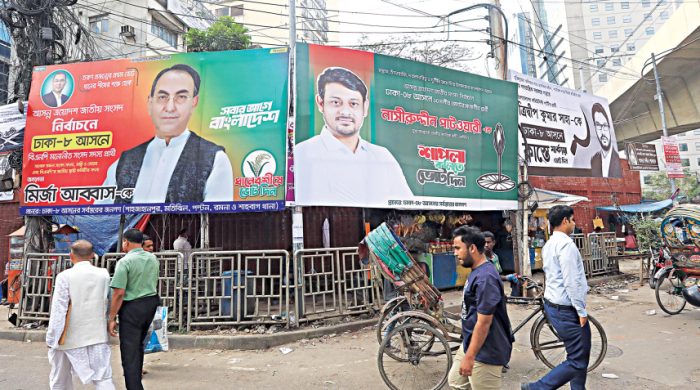
Banners hung over the streets. Rickshaws with loudspeakers moved through neighbourhoods, broadcasting messages that often came with rhythmic music.
In a country where some 2,000 candidates from roughly 50 political parties are competing for seats, the campaign season has become its own micro-economy, a temporary boom that enriched some and bypassed others.
THE WINNERS OF ELECTION SEASON
Sagir Ahmed has been in the microphone-rental business in Bancharampur, Brahmanbaria, for years, but he has never seen demand like this.
“I have to contact smaller mike service providers in the district to collect loudspeakers and supply them to candidates.”
His rates have doubled to Tk 1,000 per day, and still, every piece of equipment is booked.
Each candidate, he told The Daily Star, spends around Tk 3,000 daily per sound system, including the microphone, a motorised rickshaw and an announcer.
There are roughly 100 microphone service providers in Ahmed’s district, and all of them are fully booked throughout the campaign season.
Tea vendors have also felt the election warmth. Political conversations take centre stage at tea stalls even in regular times. But during campaign season, it booms.
People gather at stalls not just to drink but to argue and debate the merits of candidates and parties.
For tea stall owners like Patuakhali’s Badal Hossain, it means longer hours and bigger profits.
Tea is the most popular beverage in Bangladesh. The country consumes nearly 9.5 crore kilogrammes of tea annually. During elections, consumption typically rises by 5 percent to 7 percent, according to industry officials.
Badal said his daily sales have climbed from Tk 4,500-Tk 5,000 to as much as Tk 6,000.
Eleash Mridha, managing director of PRAN Group, one of the country’s largest food processors, has seen this pattern repeat itself election after election.
“Demand for fast-moving consumer goods rises by 20-25 percent during campaign season, driven especially by tea, biscuits, and puffed rice,” he said.
This year, tea and coffee sales have already increased, though soft drinks are yet to see a similar surge, he noted, adding that with warmer weather and greater public engagement expected next week, demand is likely to grow further.
Meanwhile, Taslim Shahriar of Meghna Group of Industries, one of the leading commodity importers and processors, said traditionally demand for sugar and biscuits rises during national elections.
“This year, we have witnessed increased demand, especially for sugar. This may be because of the ensuing Ramadan and the election,” he said.
Meanwhile, restrictions on plastic banners and the emphasis on digital campaigning have shifted money elsewhere — to Facebook and YouTube advertisements, to TikTok promotions, to the kind of virtual presence that leaves no physical trace.
Many candidates have hired photographers, videographers and social media content creators, while supporters broadcast events live.
Money flows to hotels and transport operators too.
WHEN REGULATIONS CUT DEMAND
But not all businesses are benefiting. Paper makers and printers are experiencing a sharp downturn because the Election Commission banned large posters for this election.
MM Nurun Nabi, executive director of Partex Paper Mills Ltd, said paper millers who registered increased business in the past elections see almost no spike in demand this year. Only leaflets are being printed.
“There had been a lot of activities in the past election. None of that is visible this time,” he said.
Md Anwar Hossain, vice chairman of Bangladesh Mudran Shilpa Samity, an association for local printers, said changes in campaign regulations and restrictions have sharply reduced demand for printed materials.
Candidates are spending only Tk 5 lakh to Tk 6 lakh on leaflets, about one-eighth of what was spent in previous elections, when candidates usually spent Tk 12 lakh to Tk 25 lakh on posters alone, he said.
“The printing industry might make Tk 100 crore this year, compared to at least Tk 800 crore in past elections,” Hossain said, adding that just 50 printers out of 5,500 might be engaged in election-related work.
Samir Dewan, an independent candidate from Khagrachhari, initially printed 2 lakh leaflets along with his election manifesto, spending only Tk 1.8 lakh. He plans to print an additional 4 lakh leaflets by the time the campaign ends.
Following the commission’s guidelines discouraging plastic materials, he opted for 20 banners made of cotton cloth.
In Cox’s Bazar, traders who rent out sound systems and run printing presses say election season has brought little business so far.
Dipu Das, who owns Art and Graphs, said past polls used to guarantee a steady stream of orders. His shop regularly designed and printed posters, handbills and leaflets as campaigns gathered pace. This year, he said, the presses have stayed silent.
He pointed to Election Commission restrictions and said many of the candidates are sourcing cloth banners themselves from Chattogram instead of placing local orders. As a result, Das said, the printing sector has seen little sign of an election boost.
Nurul Islam, owner of Cox’s Bazar Mic Service, said candidates have also reduced the use of loudspeakers.
In earlier elections, he said, a single candidate would often rent around 15 mikes for campaigning. This time, the activity has been muted. In the Cox’s Bazar-3 constituency, two candidates hired three mikes each, while the other two took just one apiece.
THE INVISIBLE SPENDING
While some campaign costs are visible — transport to ferry supporters, loudspeakers at rallies, election camps — much remains invisible and unreported.
Transparency International Bangladesh (TIB), in its study on the previous parliamentary election, provided a list of items on which candidates spent beyond visible costs.
This includes payments to activists, spending on food, donations to religious institutions and clubs, the cost of securing nominations in some parties and mobile messages.
According to candidates’ affidavits, the combined total expenditures declared for this parliamentary election are roughly Tk 400 crore. But including invisible or underhanded transactions, actual spending by candidates, especially from major political parties, is believed to be much higher.
TIB found that during the previous parliamentary election in January 2024, the average expenditure per candidate from the pre-announcement of the schedule to election day was Tk 1.56 crore, six times more than the Tk 25 lakh limit imposed by the Election Commission.
“The major items of expenditure are posters, election camps, public meetings and expenditure on workers,” it said, adding that “violation of the election expenditure limit has increased significantly.”
Nurul Huda Sakib, a professor of government and politics at Jahangirnagar University, said election expenditure in Bangladesh remains effectively unlimited despite formal spending caps.
Although visible campaign costs have declined this year because of stricter regulations and a shorter campaign period, the bulk of election spending lies elsewhere and remains largely unaccounted for, he said.
“Transport, costs for campaigners and supporters, processions and rallies are difficult to calculate precisely,” Sakib said. “More importantly, the biggest expenditure comes from the use of money and muscle power.”
Sakib, who has studied political financing, said estimating election costs at Tk 20 crore per candidate would not be excessive. On election day, costs rise sharply for mobilising people, influencing polling centres and paying polling agents.
“There is no fixed calculation,” he said. “Someone may provide Tk 500, another Tk 5,000. In some areas during past elections, candidates went door to door and handed out Tk 500 to Tk 1,000 per person.”
His assessment aligns with a February 2025 report by the Westminster Foundation for Democracy, which found that candidates often spend between Tk 3 crore and Tk 5 crore for campaigns, depending on the constituency, reinforcing a wealth-driven political system.
A TEMPORARY BOOST
Khondaker Golam Moazzem, research director at the Centre for Policy Dialogue (CPD), said election spending creates short-term economic activity and provides increased income opportunities for small businesses.
“For many local businesses — printers, decorators, sound system providers, food vendors — this period offered a rare economic opportunity,” he said. “Even a small rally needs mikes, tea, food, bamboo and cloth. That brings a temporary buzz to the local economy.”
He emphasised that even with fewer courtyard meetings and reduced campaign scale, the impact on micro-businesses was tangible, if short-lived.
However, questions of transparency in spending remain. With a spending cap of Tk 25 lakh per candidate and little oversight, untraceable money flows into campaigns under the guise of social events.
“This is someone’s cost, but another’s income,” Moazzem said. “It’s a real but fleeting boost, and one we still fail to regulate properly.”