Special Correspondent:
The government has decided to formally file a case against those allegedly involved in the unconstitutional and unlawful seizure of state power on January 11, 2007, commonly referred to as the “1/11 changeover.” The trial is expected to take place at the International Crimes Tribunal, and formal charges may be submitted shortly after Eid-ul-Azha.Chief Prosecutor of the International Crimes Tribunal, Md. Aminul Islam, has reportedly stated that retired Lieutenant General Masud Uddin Chowdhury was one of the key figures behind the alleged crimes against humanity committed during the 1/11 government period.
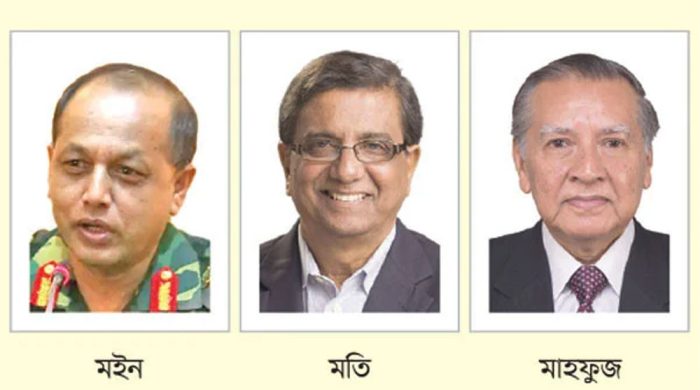
According to sources, several former military officials accused of involvement in the 1/11 events have recently been arrested and taken on remand for questioning. Investigators reportedly focused on uncovering details surrounding the background and alleged conspiracy behind the political changeover. Officials involved in the investigation claim that the detainees have started revealing information, providing what they describe as a clearer picture of the events of that time.Investigators have identified three prominent individuals, all reportedly sharing the initial “M” in their names, as central figures behind the alleged conspiracy. They include former Army Chief General Moeen U Ahmed and two senior newspaper editors often associated with civil society — Matiur Rahman, editor of Prothom Alo, and Mahfuz Anam, editor of The Daily Star.
Intelligence sources allege that the two editors played a significant role in planning the 1/11 transition and acted as intermediaries between sections of civil society and the military. According to the claims, they advised on the formation of the caretaker administration led by Fakhruddin Ahmed and influenced key policy decisions of the government.During questioning, retired Lt Gen Masud Uddin Chowdhury reportedly claimed that a section of civil society lobbied internationally to sustain an unelected government in Bangladesh for the long term. He further alleged that attempts were made to create artificial political instability and stage “militant incidents” to portray Bangladesh negatively before the international community. According to him, the armed forces became involved at the final stage after concerns emerged that Bangladesh’s participation in UN peacekeeping missions could be jeopardized. He claimed the military was not part of the original plan but was involved in its implementation.Masud Uddin Chowdhury also alleged that a leading Bangla daily and an English-language newspaper deliberately attempted to create public resentment against politicians. He claimed that nationwide seminars and roundtable discussions promoting “depoliticization” and the selection of so-called “qualified candidates” were organized to influence public opinion.
Investigators further claim that during the two years following the 1/11 transition, the two newspapers effectively acted as unofficial spokespersons for the military intelligence agency DGFI. Allegedly, unverified information extracted through interrogation and torture of political leaders was published as “special reports” without proper verification.The report also references past public remarks by Daily Star editor Mahfuz Anam, who had acknowledged in a television talk show that information provided by intelligence agencies had been published without adequate verification. Prothom Alo editor Matiur Rahman had also reportedly described the 1/11 intervention as “inevitable” in a previous interview.According to investigators, the so-called “Minus Two Formula” — an alleged plan to permanently remove the country’s two major political leaders from politics — was promoted through media narratives created by these outlets. They also allege that efforts were made to create divisions within political parties and promote “reformist” leaders. Despite allegations of inhumane treatment and torture of political detainees, including BNP leader Tarique Rahman, the newspapers allegedly ignored human rights concerns while supporting a depoliticization agenda.Former DGFI chief retired General Mamun Khaled reportedly told investigators that on January 8, 2007 — just three days before the power shift — the two editors held a secret meeting with then Army Chief General Moeen U Ahmed at Army Headquarters for more than two hours. According to his statement, the final framework for the transfer of power was decided during that meeting.
He further claimed that the written speech delivered by then-President Iajuddin Ahmed while stepping down from his advisory role had been drafted by one of the editors associated with the civil society group, a detail allegedly confirmed to him by General Moeen himself.
Both Lt Gen Masud Uddin Chowdhury and General Mamun Khaled reportedly told investigators that the “real mystery” behind the 1/11 events lies with the two editors and that questioning them would reveal the full truth.
A responsible source at the International Crimes Tribunal has confirmed that a formal investigation into alleged crimes against humanity committed during the 1/11 period is expected to begin early next month.